
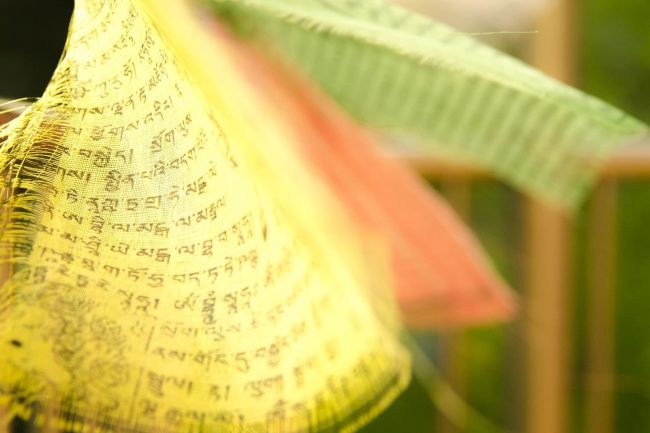
Clicking on the link for each mantra below will take you to a page where you can read about that mantra, see the figure associated with the mantra (where applicable), and listen to an audio version of the mantra.
You can chant along to the mantra until you’re confident that you have it fully memorized. There are ten repetitions of each mantra (more or less) to help give you time to learn the mantra and chant along. You can replay the mantra until you think you’ve got it.
Please note that the mantras as written on this site lack some of the diacritic marks that allow for an accurate representation of the pronunciation.
(Diacritics, or accents, are little marks that indicate how a letter should be pronounced. Pali and Sanskrit have many more letters than the Roman alphabet, and these marks allow us to extend the number of characters available to us. Diacritics include the macron — a bar over a vowel that lengthens the vowel sound — overdots, underdots, and tildes. Unfortunately not all fonts possess those diacritic marks, and although some fonts do have the full range of accents not all computers have those fonts installed. There’s therefore no reliable way to represent diacritics on the web. You therefore may sometimes see strange characters or question marks in words.)
It’s best to listen to the audio files in order to get a better appreciation of how they are pronounced (taking into account the fact that I have a Scottish accent). In the heading of each page I’ve represented long vowels with a double vowel (eg. aa) or, where it’s possible to reproduce these in html, with a letter and diacritic mark (e.g. ?).
Note: Tibetans typically pronounce some Sanskrit sounds in a non-Indian way. For example they’ll tend to pronounce “padme” (pa-dmé) as peh-mé, and “svaha” as soha. Those who are familiar with the Tibetan pronunciation will therefore notice differences such as these.
Buddhist Mantras not associated with figures
Sabbe satta sukhi hontu
Om shanti shanti shanti
Gate gate paragate parasamgate bodhi svaha
Buddhist Mantras associated with Buddhas and Bodhisattvas
Avalokitesvara: Om Mani Padme Hum
Manjushri/Manjughosa: Om A Ra Pa Ca Na Dhih
Vajrapani: Om Vajrapani Hum
Green Tara: Om Tare Tuttare Ture Svaha
Amitabha: Om Amideva Hrih
White Tara: Om Tare Tuttare Ture Mama Ayuh Punya Jnana Pushtim Kuru Svaha
Shakyamuni: Om Muni Muni Mahamuni Shakyamuni Svaha
Padmasambhava: Om Ah Hum Vajra Guru Padma Siddhi Hum
Bhaisajyaguru (Medicine Buddha): Om Bhaishajye Bhaishajye Mahabhaishajye Bhaishajyaraje Samudgate Svaha
Vajrasattva: 100-Syllable Mantra.
By following the links you can find out the meanings, pronunciations, and benefits of the Buddhist mantras listed above.

184 Comments. Leave new
thanks B . also do let me know when it goes on CD or online download if that is not to much trouble.
take care
Hi S.
I’d suggest that you sign up for our monthly newsletter since I’m likely to forget to let you know. You can sign up using the form on our home page. I hope we won’t keep you waiting too long.
All the best,
Bodhipaksa
Dear Sir
Which is the most powerful mantra or prayer in Buddhism
I’m aware of Om namu myo ho renge kyo
and Om mani padme hum
Thanks
rajjeev
Hi Rajjeev,
I don’t think in terms of there being mantras that are less or more powerful. In Buddhist practice it’s the quality of attention that you bring to a practice that makes it effective. If you do any mantra with as much mindfulness, faith, and concentration as possible, then that mantra will be a powerful one.
It helps if you pick a mantra you’re attracted to — and in some cases that means picking a mantra that’s associated with a Buddha or bodhisattva that you’re attracted to. The interest and faith that you have in the deity will help you commit yourself to the mantra.
All the best,
Bodhipaksa
In the Chinese transliterated version of the Cundi mantra, after
‘Om Cale, Cule, Cunde Svaha’, the Chinese version has a closing phrase; “Om Bu lin”.
Do you have any idea what the original Sanskrit may have been and what it means? Thank you!
I’m afraid I couldn’t begin to guess. Anyone else?
I dug around and found that the ‘Bu Lin’ is representing Sanskrit ‘Bruhm’. I looked around more for ‘Bruhm’, and it appears to be related to ‘Brahm’ (maybe?).
So, Om Bruhm/Om Brahm being used to close a mantra recitation, might be an invocation of the divine spirit in creation? That is my current theory.
The original Sanskrit syllable is bhr?ṃ à ¤Âà ¥Âà ¤°à ¥‚à ¤‚ (pronounced boron in Japanese, and bu lin in Chinese). Bruhm is just a spelling mistake I think.
In Shingon bhr?ṃ is associated with Ekākśara-uśṇī¹£a-cakra (Ichiji kinrin) – Wheel of the Crown of a Single Syllable. Also with the Karaṇá¸Âa-mudrā dhāraṇī. For more on Uśṇiśa in Japanese Buddhism you could try Grotenhuis Japanese Mandalas.
Other Uśṇiśa deities are found in Buddhism as well.
A Tibetan version of the syllable can be seen here.
My Siddhaṃ calligraphy is here.
Another aspect of this bīja is that the strokes include elements of all the 13 main Shingon Deities and so is said to represent them all in one bīja.
bhr?ṃ is not obviously related to brahm. It could be bhr? meaning ‘brow’ (they are actually cognate) – bhr?maṇá¸Âala is the arc of the eyebrow for instance. It may hark back to the verbal root bhá¹› (to bear) which gives us bhr?ṇ (to hope, fear etc) and bhr?ṇa (an embryo). None of these are particularly connected with the ideas above – but that is mantra for you.
Bhr?ṃ is being used here as a bīja for Cundī. Nothing to do with divine spirits or creation or Brahma.
See also here where they also suggest bhrum rather than bruhm in relation to Cundī
Regards
Jayarava
Jayarava,
Thank you immensely!!! For sharing your scholarship and insight with me! I am grateful to benefit. It would otherwise have taken me much longer to find this information.
Yes, the syllable was referred to as the Great Wheel One Syllable Mantra, and so I’m fairly certain that your interpretation is correct. Thank you again!
Hi there,
I have a question regarding the importance of pronunciation of mantras. Currently I am chanting the 100 syllable Vajrasattva Mantra and I am aware of the different ways as to how the mantra is pronunced (i.e. Sanskrit, Tibetan, which differs quite a lot). I am thus quite confused as to whether it is really important to get the pronunciation perfect (like the Brahmins who insisted on absolutely correct pronunciation). I’ve read websites that said the attitude behind the chanting of mantra is more important than mere pronunciation – and this sounds like a very comforting advise.
What do you guys think?
Cheers
Arthur
Hi Arthur
You can find my thoughts on this on my blog: A Pronouncement on Pronunciation.
Jayarava
Thanks Jayarava. It was very comprehensive and I like what you said about getting as close to the original pronunciation (Sanskrit) as possible. Of course, this doesn’t mean the Tibetan way of saying the mantra is bad or wrong. I guess it bears down to personal conviction, at the end of the day.
I also heard the mp3 of the Vajrasattva Mantra you put up and am using it for my mantra chanting – personally, I would like to be as close to the original language as possible.
Thanks again, Jayarava.
To quote from jayarava’s excellent (but long) article:
Hi,
I love animals a lot, this includes the stray. Which mantra should i recite to bless all animals? Thank you.
Hi Celine
I love animals too. I’ve got 5 dogs and 2 cats at home. =)
My Rinpoche told me I could chant the Green Tara mantra for all animals. I also read from one of the websites that we could chant the Medicine Buddha mantra for animals and that any animals that hear the Medicine Buddha mantra will be reborn into a higher realm of beings in their next life.
Hope this helps.
Cheers
Arthur
Dear All,
I once read about reciting Medicine Buddha mantra for dead animals, and that can inculde
reciting it for the meat of animals sold in shops, supermarkets etc etc..
These poor animals had gone through ‘killing’ , reciting Medicine Buddha mantra helps to
overcome suffering.
Medicine Buddha mantra
—————————–
NA-MO BHA-GA-VA-TE
BHAI-SAJ-YA GU-RU VAI-DUR-YA
PRA-BHA RA-JA-YA
TA-THA-GA-TA-YA AR-HAN-TE
SAM-YAK SAM-BUD-DHA-YA
TAD-YA-THA…..OM,,, BHAI-SA-JYE, BHAI-SA-JYE ,
BHAI-SAJ-YA
SA-MUD-GATE SVA-HA
———————————————-
A shorter version from Tibet ( Medicine Buddha mantra )
Tayata
Om Bekandze Bekandze
Maha Bekandze
Radza Samudgate Soha
The mantra means:
May the many sentient beings
who are sick,
quickly be freed from sickness.
And may all the sicknesses of beings
Never arise again.
===================================================
A Story of Karmic Theory
—————————–
A glamorous fashion consultant was once diagnosed with cancer. This is how she attempted to alleviate her suffering:
She sent a message through a friend of hers, a student at the Vajrapani institute in California, to ask for advice about healing practices. She was advised to buy animals that were in danger of being killed and to then free them in a safe place, thus enabling them to live longer.
This charming woman saved many animals from places where they were going to be killed. She actually freed two or three thousand animals, mostly chickens, fish, and worms. She had the chickens taken care of on a farm, and she freed the fish in open water. She also bought two thousand worms because they were cheap and readily available, and released them in the garden outside her home.
Liberating worms was believed to be a particularly good idea as they go straight under the ground when they are released. Since they have some protection there from predators, they have a chance to live longer.
It was less certain that animals freed in forests, lakes, or the ocean would have lived longer because they have natural enemies in those places.
It is said that when she returned to the hospital for a checkup after doing these practices, the doctors could not find any trace of the cancer.True or not, this story should not come as a surprise to those subscribing to the karmic theory.
My true story
—————
My dear friend’s mom met with an accident on November 7, 2008 ( in Shanghai )
She was in coma with serious head injury and several doctors were attending to her.
All I did was to recite Medicine Buddha mantra for her, and I liberated over 500 birds
sparrows. From the market I bought small live fish ( fish for cooking soup )
and I probably liberated over 200-300 fish in a pond. The cost one kilo fish is about
USD 2.
She came out of her coma in the 4th week, and got better through continuing medical treatment until she
was discharged 8 months later. She is doing very well now, her memory is about 30%
imparied, but she could walk again, eat by herself and handle simple conversation.
She could remember me, an old friend.
We thank Lord Medicine Buddha for helping when it was most crucial, it was a
matter of life and death.
With warm regards.
Kelvin
I am new to the teachings of Buddha. I have recently acquired some new Tibetan Mala Meditation beads to move into the next step of my desire for inner peace and success in my life and career.
What would be a good mantra for me to start with and how long should i use this Mantra(i.e weeks, months) Peace and wisdom to you.
Regards,
Travis
Hi Travis,
My experience has been that mantras are a very personal thing. People experience a number of mantras and begin to learn about the Buddhas or Bodhisattvas (if any) that they represent. At some point something “clicks” and a fascination develops that’s a bit like falling in love. And for years — perhaps the rest of your life — you find yourself turning to that mantra. For me, it was Padmasambhava. For you — well, you’ll have to find that out!
All the best,
Bodhipaksa
Hello, friends!
It’s been a long I’m looking for a sanskrit original dharaṇi, without any chance to find it out. It’s name is The Marvelously Beneficial Disaster Preventing Dharaṇi, but this is the translation of the tittle in japanese. All translations of this powerful dharaṇi I could find are in korean, or chinese or japanese, but I cannot find out the original sanskrit dharaṇi. I only could find out in a text a couple of lines:
Om! Khya khya khyahi khyahi, Hum hum!
Jvala jvala prajvala prajvala!
But I cannot find out the complete dharaṇi in sanskrit. Can someone help me? Thank you very much!
The short answer is I don’t know where you would find this dharani in Sanskrit. It’s always possible that the original has been lost, or even that there was no Sanskrit original.
I have already found it!!!!
Namaḥ samanta buddhānāṃ
Apratihata śāsanānāṃ
Tadyathā Oṃ kha kha
Khāhi khāhi h?ṃ h?ṃ
Jvala jvala prajvala prajvala
Tiśṭha tiśṭha śṭri śṭri
Sphuṭ sphuṭ
śāntika śrīye svāhā!
Thank you, anyway!
Great! Where did you find it?
I find it in a french site:
https://www.zen-occidental.net/sutras/shosaishu.html
To find out other texts in sanskrit original, this site is very useful:
https://www.uwest.edu/sanskritcanon/dp/index.php?q=node/107
See you!
Dear Bodhipaksa,
Read about this dharani posted by Anibal, described as ‘Powerful Dharani’.
Please help to fill in the ‘blank’ boxes as I do not know the missing alphabet letters.
Marvelously Beneficial Disaster Preventing Dharani is directed for what purpsoe or use, specifically
as it is titled ‘Disaster’. In other words, what benefits can be bring for chanting, and is this a popular
dharani?
Thanks & brgds
Namaḥ samanta buddhānāṃ
Apratihata śāsanānāṃ
Tadyathā Oṃ kha kha
Khāhi khāhi h?ṃ h?ṃ
Jvala jvala prajvala prajvala
Tiśṭha tiśṭha śṭri śṭri
Sphuṭ sphuṭ
śāntika śrīye svāhā!
The site AnÃÂbal linked to says, “As the name suggests, the recitation of this Dharani is intended to avoid the calamities of all kinds” and also that the dharani is recited daily in SÃ…ÂtÃ…Â monasteries. So it seems to be common.
Hi Anibal,
Would you know the missing alpabet letters ( blank boxes ) in the dharani?
Thank you.
Namaḥ samanta buddhānāṃ
Apratihata śāsanānāṃ
Tadyathā Oṃ kha kha
Khāhi khāhi h?ṃ h?ṃ
Jvala jvala prajvala prajvala
Tiśṭha tiśṭha śṭri śṭri
Sphuṭ sphuṭ
śāntika śrīye svāhā!
Hi K.
There are no blank letters — it’s just that you don’t have a unicode font installed in your browser. Here’s the mantra in a Harvard-Kyoto transliteration (I hope I got this right):
namaH samanta buddhAnAM
apratihata zAsanAnAM
tadyathA OM kha kha
khAhi khAhi hUM hUM
jvala jvala prajvala prajvala
tiSTha tiSTha STri STri
SphuT sphuT
zAntika SrIye svAhA!
Well, only in the case of the mantra Sphuṭ, the correct Harvard-Kyoto transliteration is sphuT:
namaH samanta buddhAnAM
apratihata zAsanAnAM
tadyathA OM kha kha
khAhi khAhi hUM hUM
jvala jvala prajvala prajvala
tiSTha tiSTha STri STri
sphuT sphuT
zAntika SrIye svAhA!
Thanks for spotting that. I knew I’d miss something…
dear mantra master :
Om Ye Dharma Hetu Prabhava Hetu ……….?
is a mantra to be found on Tsa-Tsa’s , miniature conical shaped clay ‘stupa’s , this mantra is maybe like an ‘essence-mantra’? what is the complete mantra ?, and would be it’s transliteration ? thanks ! Paul
Hi Paul,
I’m no “mantra master,” or Sanskrit scholar, but this appears to be a Sanskrit phrase that’s been turned into a mantra and Tibetanized: [OM ] Ye dharma hetu prabhava, hetun teshan Tathagato hyavada, Teshan cha yo nirodha, evam vadi Maha Shramanah [ye svaha]. This would seem to mean “All things proceed from a cause; this cause has been declared by the Tathagata; all things will cease to exist; this is what is declared by the Maha Samana.” In other words it’s a statement of pratitya-samutpada, or conditioned co-production (also known as dependent arising).
By the way, I found the “mantra” here: https://www.tsatsastudio.org/practice.htm.
And I found a translation in Google Books’ “Journal of the Royal Asiatic Society of Great Britain and Ireland, Volume 16” (https://books.google.com/books?id=rvkAAAAAYAAJ).
[…] yoga” would develop from its rich monastic tradition. As with certain Hindu, Sufi and Tibetan Buddhist practices, the Orthodox commitment to the Jesus Prayer seeks to connect the practitioner directly […]
Respected sir,
I would be greatly privileged if u write the homage mantra to Ashtamahabodhisattvas. And have got any knowledge about the meaning of the following verses from the homage song to five jina Buddhas, as i have been performing classical dance on this for long, and yet some words are out of my forte,:
second verse: varada tripta nara lokesham
aha mokchhya wangchhita manasa
swami charana ratnashri.
last verse: watsara shri nepalikum
aha geet granthita kusuma mala
namami shri dharmadhatu sharanum
and isn’t dharmadhatu another name for avalokiteshvara or is it the bodhitatwa that he holds. tell me its literal meaning n meaning of above mentioned verse.
faithfully,
Indukumuda
Hi, Indukumuda.
Thanks for sharing this. The Sanskrit seems rather garbled, and I’m not a Sanskrit scholar by any means and would have difficulty working out what it says.
I can tell you, though, that dharmadhatu is a term meaning Reality, or the way things are in their inherent emptiness. Dharmadhatu isn’t a name for Avalokiteshvara, although his nature (along with all things) is Dharmadhatu.
I’ll ask my friend Jayarava to take a look at the Sanskrit.
All the best,
Bodhipaksa
Indukumuda – do you have it in à ¤¦à ¥‡à ¤µà ¤¨à ¤¾à ¤—à ¤°à ¥€ or another Indian script. My Sanskrit has got pretty rusty, but without the proper spellings it is a hopeless case.
The last line might be something like:
à ¤¨à ¤®à ¤¾à ¤®à ¤¿ à ¤¶à ¥Âà ¤°à ¥€à ¤§à ¤°à ¥Âà ¤®à ¤§à ¤¾à ¤¤à ¥ à ¤¶à ¤¾à ¤°à ¤£à ¤‚
“I call the glorious Dharmadhatu my refuge”
Best Wishes
Jayarava
nawayz my sanskrit teacher anwered me to some extends.
b sides i wonder if u know any long homage mantra to tara . if u do plz answer n wat ’bout mantra for 8 bodhisattva?
p.s:(i’m a tenth grade student from nepal)
Hi Indukumuda.
I’m not sure whether you’re addressing your question to me or Jayarava, but I don’t know any long mantra to Tara, nor any mantra for the eight bodhisattvas.
If you do manage to get an accurate version of the homage mantra you originally asked about, could you please post it here?
Many thanks,
Bodhipaksa
dear bodhipaksa,
well i hav managed to get both mantras in my new bought Daily Practice mantra Book from swayambhunath stupa but its in tibetan… is it ok?
well wishes,
indukumud
I don’t think it makes much difference what language the mantra is in if we don’t understand the literal meaning of the mantra (assuming it has one). If a mantra has a literal meaning then presumably it’s better to understand that since the mantra is then working on more levels (that is, in addition to the mantra being a pleasant sound that we’re mindful of, and the chanting being a devotional act, it’s also a source of meaning). But if we don’t understand the literal meaning of the mantra (which is the case, for example, when I chant anything in Tibetan) the mantra is still effective as a practice of devotion and mindfulness. It doesn’t seem to me to make much difference whether the sounds we’re chanting (and don’t understand) are in Sanskrit, Tibetan, or some mangled form of one of these languages — which is often the case :)
n i suppose u should involve the seven linear prayer to guru rimpoche(padmasiddhi) too. trust me its really owesome!!
tc!
I’m familiar with and love the seven-line prayer to Padmasambhava. I’ve never thought to include it here, although perhaps I should.
Hi Bodhipakśa,
Some thoughts on this discussion, which probably won’t be new to you, but perhaps to others.
It used to matter to Buddhists that pronunciation was correct. K?kai mentions this matter in his writings on several occasions and one of the main reason that Siddhaṃ writing survives in Japan 1200 years after being introduced by K?kai is for the phonetically accurate transcription of mantras. That said almost no one, not even Indians, pronounce Sanskrit as it was pronounced in Medieval times when mantras were composed. Tibetan has very wide variations in pronunciation in Tibet let alone in the West.
Not withstanding any of this, Buddhists never seem to have bothered much with what a mantra means. What a mantra does – the magic it performs – has always been the primary thing. There is no traditional text that I know of which goes into what mantras mean in the semantic sense – though I know of several which explore associations not related to the words, but to individual syllables, or even parts of syllables. Mantras occur in texts to accompany and ’empower’ specific actions usually, or to invoke particular deities.
So I agree with you that mantra is effective in devotional and mindfulness practices, and in these contexts pronunciation is less of an issue if the intention is clear. Though I would argue that pronunciation has aesthetic value even here.
BTW I have an accurate version of the 7 line prayer in Unicode Tibetan and Roman if you want (i need to update visiblemantra because it has errors) – checked by a friend who speaks Tibetan.
Best Wishes
Jayarava
To both venerable,
Then i guess i should insert both of the mantras (of tara and auspicious mantra of 8 Bodhisattva) with their accurate meanings. yet i apologies, for it can be done only after a month. since i am to appear for school leaving board exam from an army boarding school, its impossible to contact you till then.
with wishes,
indukumud
(p.s.: i’m to learn tibetan right after this exam in my three months vacation)
Thanks for your contribution, Jayarava. I think a lot of modern practitioners in the west are interested in the literal meanings of mantras, beyond associations with the syllables. It’s interesting that that’s a new phenomenon.
Hi Bodhipakśa
Yes. I’ve tried to provide literal meanings on my website where I can find them out.
I suppose there is a fundamentally different world view behind mantras that it is hard for us to experience them as intended by their composers. Foucault talks about the kinds of changes that the European Enlightenment brought in his book ‘The Order of Things’ – knowledge coming primarily through resemblance and association was replaced by knowledge through difference and distinctiveness.
The associative link ups based on number – 5 syllables, 5 wisdoms, 5 poisons etc; 6 syllables, 6 elements, 6 realms, etc – don’t make sense to us in the way they made sense in medieval India.
Also Saussure brought in the idea that syllables have only an arbitrary connection to what we mean when we speak, which pervades modern scientific linguistics. This precludes the syllable making *any* sense on it’s own. There is some research which undermines this view, but it is difficult to get published. Margaret Magnus’s book Gods of the Word presents her PhD work to a general readership. I think eventually it will tie in with the philosophical work of Mark Johnson and George Lakoff who are exploring the way that physical interactions with the world structure metaphor and other abstract modes of thought.
The parts of the brain which control hand and mouth motor neurons are both near the language centres of the brain. So I think modern science may be drawing us back to an understanding of the symbolic richness of spoken sounds. Not there yet though.
Of course there are lot of Romantics and other EE dissenters around who are happy to just chant. Sometimes I enjoy just chanting too without knowing or needing to know why I enjoy it. Especially in big groups.
I am very intrested in buddism, but my only problem is i live in leeds, west yorkshire, UK. There isnt anywhere that i can borrow books from, i have looked in libuarys but none have any i can not afford to buy them as i am on a very low income ( social security) im also disabled. I was wondering if there is anywhere that i can get or rercieve them from free. I do have my Malla and only mantra i know is Om mani padme hum and would like to know more mantras. I hope that you can help me. thankyou ray
Hi Ray:
Probably you can go to any Buddhist Centre in Leeds and they can help you. Remember, practice and readings must go together:
Jamyang Buddhist Meditation Centre
https://www.jamyangleeds.co.uk/
Leeds Buddhist Centre
https://www.leedsbuddhistcentre.org/
If you prefer Zen Buddhism:
International Zen Association UK – Leeds Zen Group
https://www.izauk.org/dojo.asp?dojo=leeds
If you prefer Tibetan:
Sakya and Karma Kagyu Tibetan Buddhist Centre – Kagyu Buddhist Group Leeds:
https://www.dechen.org/centres/northeast/leeds.html
I hope this can help you!!
Cheers!!!
Thankyou Anibal
for your help i have e-mailed them to see how much it will cost and with me being disabled on crutchs no right kneecap and due to have my left one removed so i cant kneel so im hopeing that they will help i would love to learn buddhism as i have my owm malla prayer beads and only mantra i know like i said is Om mani padme hum and would love to learn more mantras and prayers and be a buddist not monk as i cant but thankyou for your help again Ray
namo tassa bhagawato arahate sammasam buddhasa…………
anyone wid its possible meaning???
Hi. Yes, it’s namo tassa bhagavato arahato sammasambuddhassa, and it means veneration (namo) to him (tassa) the blessed one (bhagavato) the worthy one (arahato) the fully and perfectly awakened one (sammasambuddhassa). It’s not a mantra, but a common salutation to the Buddha.
Greetings Bodhipaksa,
I though to put this here as for the good of it’s readers.
Mild description-praise to twenty-one Tara:
(Om tare Tuttare ture swaha)
:OM, obeisance to Tara, revered and exalted
Homage to Tara, swift and courageous
Who dispels all fear with mantra ‘Tuttare’
Who liberates by giving all benefits by ‘Ture’
With the syllable Swaha I bow to you.
Twenty-one salutations:
1* Homage to the saviouress, swift and courageous,
Whose gaze is quick as a flash of lightening,
Who on a tear from the face of Chinrezig
Sprang forth from a billion-fold lotus pistil
2* Homage to her whose face is like
The accumulation of a hundred full moons of autumn,
Who like a cluster of thousand stars
Radiates light that clarifies everything.
3* Homage to her who is golden blue-green,
Whose hand is adorned with the water born lotus
Charity, endeavor, austerity and peace,
Patience and Samadhi are the field of her action
4* Homage to her, the crown jewel of Tathagatas,
She who enjoys the most infinite victory,
Whoever obtains all the transcendent virtues,
Those heirs of the Conqueror take her support.
5* Homage to her who by ‘hung’ and ‘Tuttare’ mantra
Fills all space, directions and realms of desire,
Pressing the seven worlds under her feet
She brings all and everything into her power
6* Homage to her whom Indra, Agni and Brahma
Vayu, Ishvara and all the gods worship,
Elements, Gandarvas and zombie-like demons,
All malevolent spirits give praise before her.
7* Homage to her who by ‘trat’ and ‘fet’
Destroys evil forces conjured by magic,
Right leg folded, left extended pressing down,
She consumes them completely with her raising blaze of
Fire.
8* Homage to her, the swift fearsome one,
She who obliterates the most tenacious of devils,
With her lotus face wrinkled in wrath,
She annihilates all enemies without exception.
9* Homage to her who displays the mudra of three precious
Ones,
With their fingers perfectly ornamenting her her heart,
Who quakes all directions without exception
By the effulgence of light from the wheel in her hand.
10* Homage to her who spreads sublime joy
From the glittering garland of lights on her crown,
From great peals of laughter from ‘tuttare’ mantra
She brings demons and universe under her power.
11* Homage to her, the assembly of protectors of earth
She has the power to summon them forth,
By ‘hung’ and the movement of her furious grimace
She completely delivers all destitute beings.
12* Homage to her whose crescent moon diadem,
All bejeweled, glows dazzlingly,
Who from Amitabha atop her vast flow of hair
Streams forth continuous rays of white light
13* Homage to her amidst a fire like kalpa’s end
She sits at the center of garland of flame
With her right leg extended and left indrawn, those
who are joyful when the Dharma wheel turns
She completely subdues their numerous foes.
14* Homage to her who slaps the earth with her palms
And tramples it under her feet,
Who by ‘Hung’ and her wrathful expression
Dominates the beings of seven netherworlds.
15* Homage to her, mother of bliss, mother of virtue,
mother of peace,
She who herself is the peace beyond suffering,
By her root mantra with ‘swaha’ and ‘om’
She overcomes even the heaviest of defilements.
16* Homage to her, those who feel great joy at the turn of
the wheel,
She annihilates the very bodies of their enemies,
By the arrangement of ten syllable awareness mantra
Surrounding ‘hung’, she is the mother who liberates.
17* Homage to her, swiftly stamping her feet
She is the manifest form of syllable ‘hung’.
Meru, Mandara and Vindya mountauns
And even the three worlds she causes to tremble.
18* Homage to her, rounded like a heavenly lake
Is the hare-marked moon she holds in her hand,
By repeating ‘phet’ with the second Tara mantra
She clears away every last trace of poison.
19* Homage to her served by the king of assembled deities,
By the gods and other muse-like divinities,
With the sheer brilliance of her armour of joy
She dispels all in auspicious dreams and quarrels.
20* Homage to her, opened like suns or full moons
Her two eyes shine forth bright light,
By reciting ‘hara’ with the second ‘tutara’
She eradicates the most violent epidemics.
21* Homage to her whose array of three syllables of
suchness
Has the power to perfectly pacify everything,
The hosts of demonic, malignant and zombie-like
Spirits are vanquished by ‘Ture’, the unsurpassable
Mother.
{This fulfils the twenty-one salutation to the exalted Tara}
thank you!
hi ray,
In my opinion, I would be of great benefits if u learn more upon the exalted Tara and her mandala. And her mantra, benfits, bodhisattva dharani and worship. This would bestow great bliss to you.
thank you!
I would like to know a saying to read or chant to someone in a coma.
I would think the best thing would be something that is meaningful to them. If this person is or was a Buddhist, then their favorite Buddhist text. If they were not Buddhist, then perhaps a novel by their favorite author. If there’s some residual consciousness present, would it not be best to present it with what it itself would find interesting and stimulating?
Dear Nick,
Ten years ago, my wife went into coma. There is very slim hope in her case after her operation. I recited the Medicine Buddha sutra, though she didn’t get well, but she did open her eyes and gripped my hand and that was the last look she got. She passed away half an hour later.
Best to you and May the blessing of the Triple Gems be with this person and you and all loved ones.
Kelvin
I began spending half hr listening to the chant Om Mani Padme Hu for a few days…just over a week or so now…and the innumerable changes it has brought about already is Amazing. I listen to it on my way to work and the way back and some mornings too to keep my perpetual anger at my employees at bay…and wonders of wonders…suddenly I find myself listening to my own calm and peace…and especially the beauty of silence when surrounded by utter chaos…It all comes down to Belief I think…I went about searching for something related to the Buddha to make me accept my anger and move forward to peace and calm…found the chant in ur site and here I am….learning my baby steps to a peaceful calm mind. Thank you very much for being around…deep inside this vast world of the web…yet so close…Thank you. Peace!
Respected Bodhipaksa,
i really appreciate the way you have been helping people out of their pain.
I m a doctor … and its just a diagnostic branch i am in. Patients do tell me at times… that just by my touch their pain was relieved. Even one of the senior surgeon had told me — i have a healing touch!’ Things are good in most part of life.
But, i lost my father when i was in school. later i got separated frm my husband. And i made a friend last year… and we promised we will be best friends forever. But somehow .. he is now gone for no reasons. I just wonder , the people i adored the most left me. and i was deprived of love & care most of the times.. even thou i gave my best to them.
Can you suggest me some divine way / chant .. so that i can regain the friendship !
It appears silly. But for me … it is a very painful thing to realize that without any reason .. my friend suddenly dosent even feel like talking to me!
Regards.
Hello, Heeral.
Thanks for your kind words. It’s good to know that what we do here is seen and appreciated.
I’m pleased to hear that you have a healing touch. I’d guess that you’re a kind person, and that you express this in your physical contact with your patients.
I’m afraid I don’t have any faith in mantras as “magical” instruments. I think they can give us confidence, and that they can make us calmer, and that they can help us to be kinder and more compassionate. And I believe that all these qualities can make us more attractive to other people. But I don’t believe that they can directly attract people to us.
Sometimes when we say, as you did, that something happens “for no reason” we know we’re not really speaking accurately. When someone acts, they act for a reason. And if this friend is not in your life, he has his reasons. So what I wonder is, can you find out what these reasons are? And if you can, can you work to get closer to him again (if his reasons allow), and can find acceptance if his reasons for not being with you are insurmountable?
This is where mantras can be helpful. They can help you find the courage to ask questions and to make contact. They can help you have the kindness not to impose on the other person if your contact is unwanted. They can help you have the patience to accept what can’t be changed. But you also have to act, and to communicate.
Hello everyone
HI I JUST WANT to ask that is there a way to stop this MANtra? because my sister said that she has a mantra and she’s talking to herself everyday and said that he can talk to people thru her minds and sometimes she cant sleep because of talking to the voices that she hears. pls someone who have a mantra to can explain what happen to my sister because it looks like she is crazy.
pls help me
Hi Chan.
I’m sorry to hear about this. Your sister needs urgent psychiatric help. This isn’t a question about mantras, or how to stop mantras. If someone is imagining that their toaster is sending them messages you don’t go to a toaster repair shop to ask them how to stop the messages. You take the person to a shrink.
I wish you and your sister well. She’s seriously ill, but she can probably be helped, at least a little, with medication and therapy.
[…] start over, not a big deal. It’s kinda like meditation lite. Here are some common mantras https://www.wildmind.org/mantras/figures. Some people put some (what I have found to be frivolous) importance on which mantras you do, how […]
My father is missing from last 7 days. Please help me if is there any mantra which can help me find him back or any news of him? Please I need help…its so painful!
I’m sorry to hear that your father is missing. I don’t think Buddhist mantras work in the way that you’re hoping they do, but they can help to calm your mind and take the edge off of your anxiety. I’d recommend the Avalokiteshvara mantra to relax you. and the Vajrapani mantra for courage.
Dear Sapna,
Try reciting Avalokiteshvara mantra, it would be helpful.
Best to you.
Kelvin