Buddha statues

Bamiyan Buddhas: Should they be rebuilt?

Stephanie Hegarty, BBC: The destruction of Afghanistan’s Bamiyan Buddhas in 2001 led to global condemnation of the Taliban regime. But the decision by Unesco not to rebuild them has not put an end to the debate about their future.

When the Taliban were at the height of their power in Afghanistan, leader Mullah Omar waged a war against idolatry.

His biggest victims, in size as well as symbolism, were two standing stone Buddhist statues. Once the largest in the world – one measured 55 metres in height – they were carved into the sandstone cliff face of the Bamiyan valley in central Afghanistan during the 6th Century …

Read the original article »

Read More

Ancient Buddha attacked by Taliban in Pakistan gets facelift thanks to Italian archaeologist

When the Taliban blew the face off a towering, 1,500-year-old rock carving of Buddha in northwest Pakistan almost five years ago, it fell to an intrepid Italian archaeologist to come to the rescue.

Thanks to the efforts of Luca Olivieri and his partners, the 6-meter (nearly 20-foot)-tall image near the town of Jahanabad is getting a facelift, and many other archaeological treasures in the scenic Swat Valley are being excavated and preserved.

Hard-line Muslims have a history of targeting Buddhist, Hindu and other religious sites they consider heretical to Islam. Six months before the Sept. 11, 2001 attacks, the Taliban shocked the world by …

Read the original article »

Read More

‘Buddha’ goes to the hospital: A convergence of science, history and art

Emi Kolawole, Washington Post: The hospital admissions sheet simply read: “Name: Buddha; DOB: 1662.”

The 350-year-old patient’s visit started with a routine x-ray in the summer of 2008. But doctors discovered there were signs of an unknown mass inside his head and yet another inside his stomach – objects that his new caretakers were intent on identifying and extracting if at all possible. The x-ray wasn’t detailed enough to make a proper diagnosis, so doctors at Shands at the University of Florida in Gainesville cleared the schedule and ordered a CAT scan.

After a trip through the scanner, receiving a radiation dose higher than …

Read the original article »

Read More

Comical genitalia

The following post is contributed by Paul Duxbury, who blogs as “poetmcgonagall” (Left wing, atheist curmudgeon with a black sense of humour and a heart of gold. Love[s] music, books, theatre, tea, and marmite). Do visit his blog.

“Comical Genitalia.” It’s not often you get a chance to use that phrase. I’m deeply grateful to an unsung staff reporter on the Sun for unleashing it on an unsuspecting world in this 2007 article, ‘Rude Buddha’ causes outrage. It was later lifted almost word for word in a Metro article – Cops probe Rude Buddha – a headline so brilliant you can forgive them the plagiarism.

The genitalia in question – a banana and two eggs – are welded onto a bog-standard statue of a seated Buddha. The work, by artist Colin Self, was probably considered rude by the good people of Norwich for a number of reasons. A banana and two eggs are surely innocent objects in themselves, but placed in the lap of a seated figure in an upstanding position, they acquire a whole new meaning. Then there’s the bronze colour of the foodstuffs, which stands out against the black of the Buddha. Finally, there’s the position of the hand curled in the lap – a classic meditation posture – suggesting an alternative activity is taking place. I’m reminded of a greeting card, with the picture of a seated mystic and the caption, “If that’s the sound of one hand clapping, I wonder what the other hand is doing?” Oh, and the statue was facing out into the street.

A Trilogy: The Iconoclasts is actually a witty spoof, melding ideas of sacred art with pop art, and evoking all the metaphorical associations of bananas and eggs. It’s a pity some people were so prudish as to complain to the police, forcing the gallery owner to turn it round so it faced into the shop. But I’d be surprised if it didn’t sell very quickly with all the free publicity. Perhaps Self got his friends to make the complaint.

So thanks to that staff reporter for adding an essential phrase to the English language – I hope it goes viral.

Read More

Shared blessings: Arlington center seeks permanent home for revered Buddha

Kathleen Burge: The bronze face of the Buddha, always serene, gazes down at recent gifts from the pilgrims who have come to see him: two apples, dried sage, a bouquet of artificial flowers, a $20 bill.

This replica of the most revered Buddhist statue in Tibet, 8 feet tall and 600 pounds, sits inside a stucco rental house in Arlington, behind Johnnie’s Foodmaster.

Although there is no sign outside, Tibetan immigrants find their way to the Bartlett Avenue property to see the only version of the Jowo Rinpoche statue in the United States. Rinpoche is an honorific in Tibetan Buddhism, used for respected teachers.

Buddhists believe…

Click to read more »

Read More

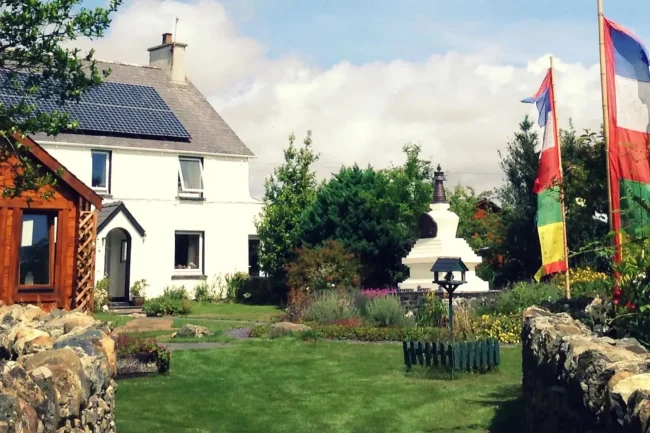
Buddhist shrine unveiled at Ynys Graianog, Criccieth

Hermitage of the Awakened Heart

A Buddhist teacher travelled from Criccieth to Kathmandu to find sacred figures for her shrine room.

Now Lama Shenpen Hookham is hoping local people who are interested in meditation will visit her retreat at Ynys Graianog where the shrine room has been enlarged to accommodate more people.

“We wanted a Buddhist image in the proper proportions and covered in gold,” she explained. “Having images is important as a kind of focus for the sacred space.

“I went out to Kathmandu this winter where there are these amazing shops full of exquisite images. I chose the ones which spoke most to me.”

Pride of place goes to a statue of Guru Rinpoche, the Indian man who first took Buddhism to Tibet and is venerated followers the Tibetan tradition, like Shenpen.

The images at Ynys Graianog also include a relic from his holiness Dilgo Khyentse Rinpoche, the teacher who prompted the establishment of this Buddhist retreat.

“Fifteen years ago he told us we should build a sacred place in north west Wales,” said Shenpen.

“It’s a tradition in Tibet to create a lake with an island and our founder, Guru Rinpoche, standing in the middle of it.

“My husband, who’s also a lama, wanted to create a place like that and his holiness said he should find a lake and a mountain west of London.”

The guru drew a square on a map, stretching from Bala to Anglesey.

“He said he would come and bless it, but died before we found this place,” said Shenpen.

“He also told us to build a stupa, a large image of the Buddha which is a focus for the presence of a sacred place,” said Shenpen. “We have drawings and an artist in Nepal who will come and create it for us.”

Shenpen came to Ynys Graianog over five years ago, but spent the first three years in meditation with only a few students for company. Now, she’s ready to open the door to local people who are interested.

“Nowadays, people are very aware of meditation and our morning, evening and day sessions are becoming more popular,” she said.

“We’re very happy for people to join in, even if they’re not fully committed Buddhists. A lot of people get comfort from learning how to meditate and there’s no need for a particular belief system. In fact, that’s exactly how I began to meditate.

“When I was 20, a Buddhist teacher said meditation would help me with my prayers: I was a Christian then, and it did help because my mind was always wandering.”

Spiritual guides

As she struggled to be a good Christian, Shenpen was glad to find a teacher who was willing to guide her spiritually.

“It’s not very well known that there is a tradition of spiritual guides in Christianity – I certainly hadn’t heard of them,” remembered Shenpen.

“As I began to understand the Buddhist teaching, it opened up so much for me and I’m still learning, even though I’m in my 60s now.”

Dedicated students commit to a long period relative isolation from the bustle of everyday life.

“If you’ve got too many things going on outside, you can’t properly meditate and see what’s going on inside you,” said Shenpen.

“But you can meditate when walking, too, and there are so many lovely places to do that around here.”

Ynys Graianog is not a public place of worship, so visitors need to get in touch before going.

[via BBC News]
Read More

Adorning your sacred space

lama willa blythe baker

In this extract from her forthcoming book, Everyday Dharma: Seven Weeks to Finding the Buddha in You , Lama Willa Miller shows how the symbolism of a shrine can help connect you with your own deepest values and spiritual potential.

A shrine is a repository for objects of inspiration. It is a material expression of your spiritual quest. It is a physical space housing symbols that remind you of your commitment to humanity, your community, or the earth, in whatever form that takes for you. These symbols can range from very personal to universal. Symbols are powerful. They speak to us in a language beyond words, and they evoke with imagery. Shrine symbols are selected to remind us of the qualities of wisdom-nature and the spiritual journey.

Start with a surface. Almost any elevated surface will do. Here are some improvisations I have made in my life: a small table, a shelf, the top of a dresser, a box covered with a cloth, a fireplace mantle, a smooth stone, and a board across two cinderblocks, covered with a cloth. For a three-year retreat, we were each supplied with a real Tibetan-style shrine with three levels and cabinet doors. This is a nice luxury if you are a carpenter or have the means to purchase a shrine. But if not, there are many options. It should be visible from your seat but does not have to be near it.

Select what goes on the shrine by how meaningful it feels to you with regard to your spiritual journey.

The heart of a shrine is the sacred objects that go in or on it. Start simple. Select what goes on the shrine by how meaningful it feels to you with regard to your spiritual journey. In other words, what you put on your shrine should be a symbolic reflection of your intention and aspirations. Shrine objects are there to uplift or inspire you. Anything that moves you to feel loving, content, and peaceful belongs on a shrine. Especially look for whatever reminds you of your wisdom-nature, the innate potential that you carry with you.

To start with, collect things from around your own home, or use natural objects from your yard or other outdoor places. See how creative you can be with what you already have. If that means putting only one object on your shrine, or even visualizing something in front of you, that is enough to start!

In 1959, when the Chinese invaded eastern Tibet, many Tibetans were placed in concentration camps. One friend of mine, a lama, was in a camp for six months before he escaped. They took everything away from him and his fellow prisoners: his monks robes, his rosary, his sacred texts — everything. He had only a Chinese uniform provided by the camp wardens. My friend used visualization and what little he had at his disposal. With no outer supports, he continued to visualize his spiritual mentors above his head, and he put aside small bits of food as symbolic offerings to them. When the guards were not looking, he would dip his finger in his drinking water and flick it into the air as a symbolic offering to the Buddha. When the lights went out at night, he sat up in meditation. He had to be covert about his spiritual practices because the Chinese guards punished any religious expression. He once told me that the period of six months in a concentration camp was the best retreat he ever had! So while objects can be inspiring and supportive, they are never as important as your mindset and intention. Objects are optional, but intention is essential.

Objects are optional, but intention is essential.

On a Buddhist shrine, you will typically find representations of the Buddha’s body, speech, and mind: a statue, a book, and a stupa. Body, speech, and mind are sometimes called the “three gates to liberation” in Buddhist sources, because — when you think about it — that is precisely where liberation is going to take place: in your body, speech, and mind (and the bodies, speech, and minds of everyone else). The physical, verbal, and mental aspects of your being are like the clay you have to work with. Awakening can be fashioned out of nothing else. Therefore, it makes sense that the most basic objects on a shrine represent body, speech, and mind, in their awakened or perfected form, because that is where we aspire to go.

The statue — the symbol of awakened body — might be of the Buddha, or it might be of some other enlightened being. It is intended to communicate that enlightenment takes form in the world, through action. The book represents awakened speech, and means that enlightenment can be communicated verbally. A stupa — representing awakened mind — is a small reliquary that comes in a few shapes, usually a carved mound or thick spire with bas-relief designs. When the Buddha died, his ashes were placed in such a reliquary, and it is believed that those relics still survive. So ever after, the shape of the stupa came to be associated with the Buddha’s undying wisdom-mind.

The question to ask yourself is: What reminds me of the potential of my mind to awaken?

If you want, you can look for symbolic representations of awakened body, speech, and mind in your own home (or these days, online). Choose objects or images that are personally meaningful. As a representation of awakened body, a statue of the Buddha is not the most meaningful image for everyone. It might be a picture of your spiritual mentor, an image of a person to whom you feel devotion, or something else entirely. On my first shrine, I placed a painting of the Virgin Mary and Jesus that I found at a garage sale as a kid, because it reminded me of the power of motherly love. Later, it was the image of Tara. Then these were joined by a Buddha statue. A shrine can be a work in progress.

The question to ask yourself is: What reminds me of the potential of my body and the bodies of everyone to become sages? The body is the vessel that carries you to awakening. What reminds you that your own body and the bodies of others are precious vessels? What reminds you that your body is an instrument of carrying out your life-intention?

The body is your sacred temple, the most sacred of spaces, where awakening occurs. What reminds you that your body is a crucible for enlightenment? Some examples of representations of body include photos of inspiring people who have used their bodies to inspire and uplift others, statues, body images, or an object that reminds you of your body’s potential. I have seen someone use a small cactus. When I asked her why the cactus, she replied, “It is like me … spiny on the outside, and soft on the inside! It reminds me to look for the softness in myself.”

You do not have to limit yourself to traditional images.

For the representation of speech, the question to ask is: what reminds me of the potential of my speech, and the speech of all people, to become enlightened? Your speech is the instrument of communication with the world. It is through speech that the mind’s wisdom and love translates into words that inspire and uplift others. The vehicle of language and speech is the reason we are able to traverse a path at all and is the conduit of teaching and learning. Some traditional representations of awakened speech include sacred books or texts, inspiring poetry, rosaries or prayer beads (symbolizing the repetition of a set of empowering syllables called a mantra), bells, chimes, drums, and conch shells. Almost anything that makes a pleasant sound could be a representation of awakened speech. In the Tibetan Buddhist environment, even the alphabet (and every letter of the alphabet) is considered inherently sacred, because it is the vehicle of the communication of sound and meaning and is sometimes repeated during prayers to bless a person’s speech. These days, a representation of awakened speech could even be a CD.

For the representation of mind, the question to ask yourself is: What reminds me of the potential of my mind — my innermost wisdom-nature — to awaken? Although the wisdom-nature has no form, if you had to give it a form, what would you choose? The Buddhists traditionally use a stupa. You could choose whatever reminds you of your mind’s potential to awaken perfect love and wisdom. Some traditional Tibetan representations of the mind include a crystal, because mind refracts the light of truth as many colors; a mirror, because all sense appearances are reflected in the surface of awareness; a jewel or vajra, because the mind is indestructible; and a sword, as a symbol that a sage’s wisdom cuts through everything else. These are just a few. You should think about what kind of symbol works for you. You do not have to limit yourself to traditional images.

Read More

A day in the life: A monk on Fearless Mountain (Ukiah Daily Journal, CA)

Tony Anthony, The Ukiah Daily Journal: Ajahn Pasanno appears out of the woods, walks up a few steps and plunks himself down in a comfortable wicker chair on the front porch of Abhayagiri “Fearless Mountain” Monastery in Redwood Valley.

The day is coming to a close and the peace and the quiet of the place is what is noticeable. The only noise is the distant sound of a lawnmower, which almost seems to come from some other world, a world different from this one. Ajahn, means teacher and is used in place of a first name for the abbot of the monastery. Pasanno means “one having faith and joy,” the name his teacher bestowed on him when he was still a novice.

It is difficult to imagine Ajahn as a young man in a secular sense, now that he is of middle age, with a shaved head and clothed in a simple mustard-colored robe. It seems he was always this person he is now. But Ajahn’s journey began in the 1970s as a young man when he left his home in Manitoba, Canada after finishing his university studies to travel the far reaches of the world. He rambled through Europe, Afghanistan and India, not seeking to become a Buddhist monk but visiting various holy places along the way.

It wasn’t until he arrived in the north of Thailand that he began to feel a sense of belonging. In order to learn more about Buddhism, he attended some classes at a monastery called Wat Nong Bah north of Chiang Mai. “I was just passing through, but the Thai society seemed to have a whole different value system. I felt at home,” he said.

After a month-long stay, the Abbot of the monastery suggested the young man consider ordination with an initial goal of remaining three or four months. Although he was not yet sure what he was getting into, he was willing to give it a try. He took on the robes of a forest dwelling monk thinking it would be only for a short time that was the beginning of the life he still lives now, more than 30 years later.

“You are not required to make a life-long commitment,” Ajahn says, “It just happened.”

The monk says he didn’t have any intuition that he would lead a monastic life.

“When I began it was to learn how to meditate.” But, he says, “at one point, it didn’t seem possible to go back.”

Thus the young monk began a practice where monks wear plain robes and shave their heads in an effort to let go of their own personal preferences.

“Doing this, is about simplification,” Ajahn says. “We renounce the world because of the peace that comes from it. The quality of peace we can access and dwell in is deeply satisfying.

“I encourage people that peace and well-being are a possibility for your life – to explore that for your life. I encourage people to use the tools of a virtuous life.”

An Abhayagiri pamphlet lists the “The Eight Precepts” for leading such a life: 1. Harmlessness: not intentionally taking the life of any living creature. 2. Trustworthiness: not taking anything which is not given. 3. Celibacy: refraining from any sexual activity. 4. Right Speech: avoiding false, abusive or malicious speech. 5. Sobriety: not taking any intoxicating drink or drugs. 6. Renunciation: not eating after mid-day. 7. Restraint: Not seeking entertainment, playing radios or musical instruments. Dressing in a modest, unadorned way that does not attract attention. 8. Alertness: refraining from over-indulgence in sleep.

Choosing to live amidst the beauty that surrounds Fearless Mountain may not seem to be renouncing the world at all, but Ajahn Pasanno says, “we even try to renounce the beauty. Most people try to get more of everything. Then when they get more they feel a loss when they lose it and don’t have it anymore. Then they lament the separation.

“A monk gets to the place of stillness. It is not rejecting anything – it’s another aspect of life that most people don’t pay attention to.”

A gift of land

There are eight monks who live at Abhayagiri, plus one novice and one postulate in training, all living on 250 acres of almost untouched forest land, originally a gift from the late abbot of the City of Ten Thousand Buddhas in Ukiah – Master Hsuan Hua. Master Hua dreamed of bringing the Northern and Southern Traditions of Buddhism together again where they could relate in an atmosphere of mutual respect and harmony.

The monastery was founded by two teachers, Ajahn Sumedho, and Ajahn Amaro after they developed a devoted following in Northern California in the1980s. The original Abhayagiri was in ancient Sri Lanka at Anuradhapura and although it follows the Theravada branch of Buddhism, the monastery was known for accepting both teachers and practitioners from many different Buddhist traditions.

“The monastery currently has more people who want to come here and be monks than the facility can handle,” Ajahn says.

A monk named Sudanto, meaning “one who trains himself well” calls Abhayagiri, “a zone of peace people can use as a community resource.” He explains the monastery’s connection with the community as, “an interrelationship that keeps us (the monks) relevant, as a peaceful presence – people with deep knowledge and experience of the Buddhist teachings of peace and wholeness.”

A day in the life of a monk

The day on Fearless Mountain begins at 4 a.m. Then from 5-6 a.m. they begin their spiritual practice with meditation and chanting. These reflections set a tone of the mind during the day. 6:30-7 a.m. there are some general chores, cleaning up and a light breakfast. At 7:30 a.m. the monks meet to delegate chores – maintenance, cooking, office tasks and the job of maintaining the miles of trails which circle through the forests. After chores, the monks have their main meal from 10:30-11 a.m.

When it comes to food, the forest dwelling monks are alms mendicants. Not allowed to plant or pick their own food, they rely on gifts. The monks can be seen on Fridays walking through the center of town collecting gifts of food.

“This creates interdependence with the lay community. We don’t want to be completely cut off,”Ajahn said.

He explains this synergistic relationship. “People from the community come to the monastery to gain more simplicity, more well being. We give the opportunity for people to have the way of living, which is more peaceful, more fulfilling. Sharing our life is sort of the by-product. If one’s goal is to teach, it can be distorted. Refocus on the quality of our lives and that becomes an example to others.”

Ajahn is suddenly explaining some of the core elements of a monastic life. “The more the I’ can get out of the way, the more peaceful things become. The monks spend the remainder of the daylight hours in their cabins where they do various forms of meditation – both traditional sitting, and walking. Ajahn explains: “Outside each cabin is a level 50-foot path where the monks develop sustaining attention on the walking – recognition of words and mental states. ”

At 5:30 in the afternoon the community gathers once again for tea. This is the time for guidance by the teacher. Help also comes from the community at large – mental support from other monks. Even monks learn from each other’s foibles. Asked if monks maintain personality traits like senses of humor, Ajahn says that even ascetic monks remain individuals and some are known for their enlightened sense of humor.

At 6:30 p.m. there is a reading where monks can ask questions, then from 7:30 to 8:30 p.m., evening chanting and meditation.

Many questions, of course, will arise even in those experiencing blissful states of mind. Ajahn explains, “of course there is a longing to repeat that experience. We don’t want to be dependent on anything. The enlightened are not dependent on anything for their happiness. Although,”he is quick to add, “there is a quality of compassion. But we strive for separation from attachments that create entanglements. We are conditioned to think we need certain things for our well-being.”

Too much eating or sleeping creates complications in life. Ajahn laughs as he mentions just how much of everything people seem to need to be happy. And then, he asks, are they ever really happy?

As the sun is ready to drop behind the mountains to the west, Ajahn Pasanno is eager to show a “walking meditation.” High up on the mountainside at the end of a path curving between the manzanita trees, is a small cabin where the monk spends most of his time in meditation. Beside the cabin is a 50-foot dirt path where he thoughtfully, mindfully walks with his eyes sometimes closed, sometimes open.

A gift from Thailand

During one evening recently, the Abhayagiri Monastery held a ceremony for the installation of a statue of the Buddha, a gift from a Thai donor. After the sun had set and the moon had risen, a delegation of monks – both resident and visiting but of the same forest tradition – sat on a wooden platform amongst the trees, chanting at the base of the statue. The scene was magical, with a hundred or more devotees from all parts of the country in attendance.

As the mountaintop had grown colder as the night grew later, the visiting abbot Ajahn Liam spoke in his native Pali, translated by Ajahn Pasanno for the western guests in attendance. “We might feel it is a bit cold – but nature is just being natural, natural to the climate and the season. It is just liking it or not liking it.” He went on to say, “Nobody wants to suffer, to experience discomfort.”

The moon was half full, sitting in the sky above the mountaintop, giving a golden glow to the resplendent life-size statue of a sitting Buddha. The breeze rushed through the trees making a sound much like ocean waves breaking on a shore. The monk’s point was that nature is always in the business of just being nature and it is up to humans not to be disturbed by the world around them. Then, only then, when we accept the world for what it truly is, are we able to see ourselves as we truly are – perfect, divine, awakened individuals – happy to be who we are.

Original article no longer available…

Read More
Menu

Wildmind is a Community-Supported Meditation Initiative. Explore the benefits of becoming a supporter.

Close Welcome Bar