Western Buddhism

Shaolin Temple’s real kick is inner peace

Closely aligned with the temple in China, the shrine in Sherman Oaks focuses on philosophy and meditation.

China’s world-famous Shaolin Temple gained prominence among many Americans with the release of the 1980s martial arts movie of the same name. An updated version of the film, loved by fans for the riveting kung fu stunts of the temple’s legendary fighting monks, is in the works. And in recent weeks, Hollywood’s remake of “The Karate Kid” has topped the box office, wowing audiences with its seemingly magical martial arts techniques.

But while kung fu continues to make a splash on the big screen, members of the Shaolin Buddhist Temple in Sherman Oaks are keen to spread a different message about the Shaolin culture and what their sanctuary has to offer.

“When people come here, it’s not just about martial arts,” said the temple’s master, Italian-born Franco Testini, 43, whose Buddhist name, Shifu Shi Yan Fan, was given to him by the abbot of the Shaolin Temple in China.

“Hollywood has completely exaggerated the martial arts scene,” added Cindy Truong, 32, a temple volunteer and event coordinator. “It’s not all about Chinese people being thrown over chairs. The martial arts you see in the movies, that’s Americanized. It’s a very small part of Shaolin culture.”

Situated on a busy stretch of Ventura Boulevard, the temple opened in 2008 and offers a tranquil escape from the world outside. Instruction focuses on Buddhist philosophy and meditation, the art of ancient Chinese tea ceremonies, a combination of stretching and breathing exercises known as chi gong, tai chi — and, of course, martial arts.

“But we don’t train people to punch and kick,” said Truong. “We train people to become strong internally, and that emanates externally. We try to educate people, that it’s more than just fighting and fancy moves.”

Testini stressed the link between breathing, listening and learning as a key to developing harmony between the mind and body.

Although there are several Shaolin schools in Los Angeles, only the Sherman Oaks shrine is listed on the official website of China’s Shaolin Temple, where it is described as “the first official branch organization in North America.”

What makes the Sherman Oaks temple even more unusual is Testini, its master.

In 2007, Testini became the first Westerner to be accepted into the elite of the 1,500-year-old Shaolin Temple in eastern central China, his supporters said. In an ancient ritual, he received the Buddhist brand marks that symbolize his high status in Shaolin culture, they added.

Articles in Chinese news media and American martial arts magazines publicized the honor bestowed on Testini, whose journey to monkhood began when he was a youngster in his hometown of Brindisi, an Italian port city.

Testini was 7 when he started taking martial arts lessons, he said. At 9, he began to compete. By his teens, he had won numerous competitions. And at age 21, he entered the monastery and eventually took vows to become a monk. His study at home was complemented by numerous trips to China’s Shaolin Temple, to solidify his discipline and faith.

In 1994, Testini arrived in the United States. He didn’t speak English and he was homeless for the first several months, sleeping on the beach or in abandoned cars. He traded martial arts instruction for food and soon developed a following of students and friends, who eventually found him permanent shelter. And in 2008, his students helped him lease a former furniture store that became the Sherman Oaks temple.

For Testini, his good fortune wasn’t the result of luck but of his unwavering conviction that “everything is within reach.”

It’s a message he preaches daily, over tea, to the more than 50 people who have become members of the temple.

“You have to learn to believe in yourself,” said the monk, who still struggles to tackle some English words and grammar.

On a recent morning, about a dozen students gathered in the shrine’s small hall, decorated with Chinese murals and ornate golden figurines, to practice chi gong. Testini drifted among the participants, gently adjusting their positions.

“He can feel your aura and energy, your intensity and anxiety level,” said Truong, as she observed what has become a familiar ritual. “Just by looking at a person’s facial expression, he can see what kind of stress they have inside.”

The breathing exercises and positive thinking Testini teaches help to relieve that stress, said Gene Cantamessa, who attends the temple five days a week.

Cantamessa, who said he is “pushing 70,” is among the temple’s longtime members, whose ages range from 2 to 80. Some are novices to the exercises and meditation; others have years of experience. Several work in the film industry and use the Sherman Oaks shrine to escape from the Hollywood hustle.

“I find the meditation very good,” said Cantamessa, a retired production sound mixer. “I like the experience of concentrating … the peace of mind. I feel like a different person when I’m in here.”

“You find a sense of inner calm,” actor Adrian Paul, 50, said of his frequent attendance at the temple. “It allows you to enter another world, which centers you. Shaolin is what ballet is to dance. It’s the foundation that gives you the ability to do what you want to do, better.”

Rosie DiPrima said she got interested in the temple after observing her children, aged 7 and 10, participate in a martial arts class.

“After a week of watching, I started participating,” said DiPrima, 37, a movie industry chef. “It’s completely changed my life.”

[Ann Simmons, LA Times]
Read More

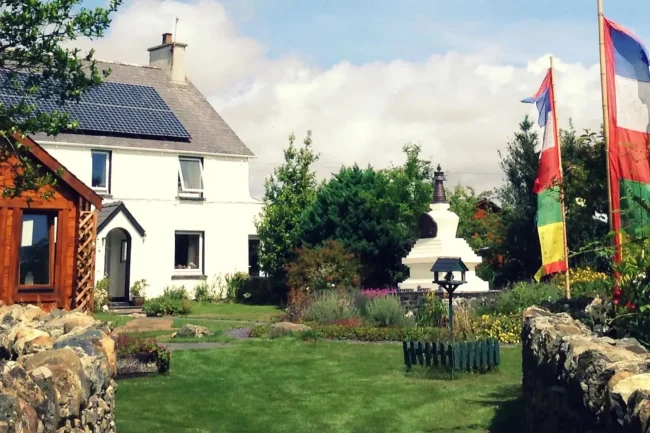
Buddhist shrine unveiled at Ynys Graianog, Criccieth

Hermitage of the Awakened Heart

A Buddhist teacher travelled from Criccieth to Kathmandu to find sacred figures for her shrine room.

Now Lama Shenpen Hookham is hoping local people who are interested in meditation will visit her retreat at Ynys Graianog where the shrine room has been enlarged to accommodate more people.

“We wanted a Buddhist image in the proper proportions and covered in gold,” she explained. “Having images is important as a kind of focus for the sacred space.

“I went out to Kathmandu this winter where there are these amazing shops full of exquisite images. I chose the ones which spoke most to me.”

Pride of place goes to a statue of Guru Rinpoche, the Indian man who first took Buddhism to Tibet and is venerated followers the Tibetan tradition, like Shenpen.

The images at Ynys Graianog also include a relic from his holiness Dilgo Khyentse Rinpoche, the teacher who prompted the establishment of this Buddhist retreat.

“Fifteen years ago he told us we should build a sacred place in north west Wales,” said Shenpen.

“It’s a tradition in Tibet to create a lake with an island and our founder, Guru Rinpoche, standing in the middle of it.

“My husband, who’s also a lama, wanted to create a place like that and his holiness said he should find a lake and a mountain west of London.”

The guru drew a square on a map, stretching from Bala to Anglesey.

“He said he would come and bless it, but died before we found this place,” said Shenpen.

“He also told us to build a stupa, a large image of the Buddha which is a focus for the presence of a sacred place,” said Shenpen. “We have drawings and an artist in Nepal who will come and create it for us.”

Shenpen came to Ynys Graianog over five years ago, but spent the first three years in meditation with only a few students for company. Now, she’s ready to open the door to local people who are interested.

“Nowadays, people are very aware of meditation and our morning, evening and day sessions are becoming more popular,” she said.

“We’re very happy for people to join in, even if they’re not fully committed Buddhists. A lot of people get comfort from learning how to meditate and there’s no need for a particular belief system. In fact, that’s exactly how I began to meditate.

“When I was 20, a Buddhist teacher said meditation would help me with my prayers: I was a Christian then, and it did help because my mind was always wandering.”

Spiritual guides

As she struggled to be a good Christian, Shenpen was glad to find a teacher who was willing to guide her spiritually.

“It’s not very well known that there is a tradition of spiritual guides in Christianity – I certainly hadn’t heard of them,” remembered Shenpen.

“As I began to understand the Buddhist teaching, it opened up so much for me and I’m still learning, even though I’m in my 60s now.”

Dedicated students commit to a long period relative isolation from the bustle of everyday life.

“If you’ve got too many things going on outside, you can’t properly meditate and see what’s going on inside you,” said Shenpen.

“But you can meditate when walking, too, and there are so many lovely places to do that around here.”

Ynys Graianog is not a public place of worship, so visitors need to get in touch before going.

[via BBC News]
Read More

Buddhist tradition thrives in Austin

Area’s diverse Buddhist scene is home to dozens of temples, meditation groups and centers

One of the most popular ambassadors of Buddhism in the West, the Dalai Lama, met with President Barack Obama in February. The meeting, which riled Chinese leaders, happened right after Tiger Woods mentioned a return to his Buddhist roots in a public apology for his extramarital affairs. Then Fox News analyst Brit Hume sparked even more discussion on Buddhism when he suggested that Woods might be better off converting to Christianity.

The national attention on Buddhism has been echoed in the establishment of new Buddhist groups and temples in the Austin area over the past decade. The faith tradition emerged in the sixth century when the wealthy Siddhartha Gautama, who lived in what is now Nepal, renounced his social status to lead a life pursuing the comprehension of human suffering.

Dozens of types of Buddhism are now practiced all over the world by more than 360 million people. An estimated 1.5 million people identify themselves as Buddhist in America. Americans became more aware of Buddhism and the dharma, the law that orders both the cosmos and individual conduct as well as the teachings of the Buddha, in the 1960s.

Last month, the Interdependence Project, a Buddhist-influenced community group and activist organization whose mission is to foster the intersection of contemplative practices and social change, started a chapter in Austin (it’s also in Portland, Ore., and New York). The project, led by psychologists Michael Uebel and Uva Most, started with an art opening at the Pedernales Lofts on East Sixth Street. That led to interest from dozens of Austinites to start an informal meditation group, Uebel said.

The project adds to Austin’s diverse Buddhist scene, which offers dozens of ethnic temples, mindfulness or meditation groups and centers that follow specific traditions. Local Buddhist teachers, priests and laypeople say there has been a visible Buddhist presence in Austin since at least the 1990s, but there are no reliable estimates of the number of Buddhists in Austin because the U.S. Census Bureau doesn’t track information about religious affiliation.

Mark Adams, 42, a psychotherapist who runs his own private practice and counsels veterans struggling with post-traumatic stress disorder, said that he came to meditation about a year ago when he became interested in mindfulness, or the practice of being more aware in everyday life. While working with his patients, he said he became more interested in his own self-care as an extension of caring for others.

Like others who have participated in the Interdependence Project, Adams said he doesn’t feel as at home in more structured Buddhist communities.

“I visited some other places and nothing seemed to stick,” Adams said.

Adherents of Buddhism, a non-theistic tradition, follow a path of mindfulness and nonviolence toward others. Buddhism emerges out of at least two major lineages: Theravada, which is atheistic and the predominant religion of Southeast Asia, and Mahayana, which translates to “Great Vehicle” and emerged from India. Tibetan and Zen traditions that are also part of the larger Buddhism pantheon each have their own slightly different emphasis on the same general principles.

Nawala Lakkhana and Pandit Eluwapola Gnanaratana Thero, Sri Lankan monks at the 5-acre Austin Buddhist Center in Southeast Austin, say they practice Theravada Buddhism at the 4,500-square-foot space, which was built in 2007. About 50 families go there for meditation, said Dilum Chandrasoma, a philanthropist whose family has been in the Austin area since 1966. It’s one of a handful of temples in Northwest and Central Austin and smaller sanghas — or Buddhist communities — that meet in far Southeast Austin and have a mostly immigrant following.

Although Chandrasoma says the Austin Buddhist Center is open to all who want to meditate there, it caters mainly to Sri Lankan immigrant families. More prevalent in Austin are the more informal groups that practice loosely connected Buddhist principles of mindfulness and contemplation without a specific religious affiliation, like the Interdependence Project.

According to the Pew Forum for Religion in Public Life, a think tank based in Washington, D.C., only one in three American Buddhists lists their ethnicity as Asian; the number of Buddhists in America made up less than 1 percent of 35,000 adults surveyed in the Pew Forum’s 2008 U.S. Religious Landscape Survey.

Chris Lance, director of the Austin Zen Center, said the center’s community of about 70 members — who meditate and attend events at the three-home campus near the University of Texas — are largely Western converts to Buddhism. The center’s main building is a two-story green home with several incense-scented rooms where cushions and chairs line the walls around altars where bronze Buddha statues sit.

The Austin Zen Center was founded in 1995 by psychotherapist and Buddhist priest Flint Sparks. Sparks, who comes from Southern Baptist roots, began the Zen center by starting a meditation group. Around the same time, Peg Syverson had arrived in Austin around 1994 and had started a meditation group as well. Sparks left the Zen Center in a full-time capacity, and he and Syverson now run Appamada, a Buddhist group that meets in Central Austin.

Webber, 63, has been meditating at the center since 2002. She lived down the street in a duplex, but at the beginning of the year moved into the Zen Center. The retired landscape designer started looking for a place to meditate after the Sept. 11, 2001, terrorist attacks. “I became aware of what could come out of the blue on a sunny day,” she said. “I thought I needed to be more prepared.”

Now there are other, smaller Buddhist communities that round out the experience of Buddhism in Austin. They include the Chittamani Buddhist Center, the Shambhala Meditation Center and several other smaller local Buddhist or Buddhist-inspired groups that meet to meditate, discuss the philosophies of nonviolence, the benefits of compassion and mindfulness, and conduct volunteer work.

But not everyone in these communities necessarily defines themselves as a Buddhist. As Most said after a recent informal meditation sit at the Interdependence Project, “Philosophically, Buddhism doesn’t demand that you choose, like other traditions. You don’t have to do anything with Buddhism except let it resonate in your life. It manifests in non-Buddhist ways in the culture, like being vegan or anti-war.”

joshundasanders@statesman.com; 445-3630

Buddhist groups in Austin

The Austin Buddhist Center

5816 Ross Road, Del Valle www.austinbuddhistcenter.org

Appamada (formerly Ordinary Mind Zen)

913 E. 38th St. www.appamada.org

Austin Zen Center

3014 Washington Square www.austinzencenter.org

The Austin Shambhala Meditation Center

1702 S. Fifth St. www.austin.shambhala.org

The Interdependence Project

2401 E. Sixth St., #2017 www.theidproject.org/regions/austin-tx

A project with groups based in New York and Portland, Ore., that allows a space for art, activism and meditation to mix. Founded by writer Ethan Nictern, the son of a well-known Buddhist teacher, the project was founded locally this year.

[via The Statesman]
Read More

“Living Ethically: Advice from Nagarjuna’s Precious Garland,” by Sangharakshita

Buddhism’s ethical code was formulated in Iron-Age India. How relevant is it for people living today? Pam Dodd, our guest reviewer, delves into Sangharakshita’s book on Living Ethically.

Living Ethically is the first of two planned volumes by British Buddhist scholar and former monk Sangharakshita on Nagarjuna’s Precious Garland of Advice for a King (Ratnamala). This first book follows a beautifully laid out interpretive journey through the Precious Garland’s rich array of common and uncommon directives for leading an ethical life.

These lessons will be a welcome addition to any Buddhist teacher or serious student of Buddhism, especially Tibetan Buddhism. Those from other Buddhist traditions or who wear their Buddhism more lightly may find the reading a challenge at times, but with patience and persistence most apparent mountains quickly turn into meaningful molehills.

Like the second century India philosopher Nagarjuna, Sangharakshita tackles ethical issues head on, never beating about the bush. His writing is honest, practical, and perceptive, helping the reader navigate the finer nuances of Nagarjuna’s advice to an ancient king with thoughtful attention to how it applies today.

Title: Living Ethically: Advice from Nagarjuna’s Precious Garland
Author: Sangharakshita
Publisher: Windhorse Publications
ISBN: 9781899579860
Available from: Windhorse (UK) Amazon.com.

Nagarjuna is a master at showing the subtle ways we evade the spirit of the Buddhist precepts. Both Nagarjuna and Sangharakshita make it patently clear how easily we let ourselves off the hook and what we need to do to hold ourselves more accountable to being more skillful as we go about our day.

The book begins with an informative chapter on Nagarjuna and an explanation of why it’s important to have a wise, experienced teacher to interpret old texts. The seven chapters that follow discuss Precious Garland verses using the framework of the Five Precepts overlapping the Ten Good Deeds.

1. Friendship

Beyond killing people, the first Buddhist precept extends more deeply to not harming living beings. Breaches include hunting (chasing and killing animals for pleasure), frightening others, violent or pornographic films, political and journalistic doom mongering, giving up on someone we find difficult, and generally getting in the way of people’s positive development as true individuals.

Several sections cover the fruits of practicing the kindness of metta bhavana. True metta towards others and ourselves puts us in an effortless, positive, and spontaneous state that brings loving friendship, mental and physical pleasures, easily getting what we need, and protection from violence.

Also discussed is right livelihood (work that doesn’t require us to violate the precepts in any way). Work we should avoid includes producing or selling alcohol and weapons of war; butchering; holding any job based on deception or dishonesty; and wasting our lives working at something we hate, find repetitive or boring, or that offers no incentive to improve our performance.

2. Generosity

Likewise, Nagarjuna says that the second precept means far more than not stealing physical things that don’t belong to us. Generosity arises from not treating things and people as commodities. The ethical person should not, for example, block other people’s development or violate their individuality by wasting their time or robbing them of their energy or be possessive or manipulate situations to his or her advantage.

Much discussion is devoted to clarifying giving and taking, including the importance of gratitude. In an ideal society, we give what we can and take only what we need. But most of us live far from the ideal. For instance, a gift is not really a gift if you’re thinking about what you will get in return. Moreover, unsolicited advice is the one assumed gift that is best withheld.

Perhaps the greatest generosity is offering help out of a sense of love, not merely a sense of duty. In other words, we should make ourselves useful when needed, not only when we feel like it.

3. Sexual Relationships

The third precept, to abstain from sexual misconduct, initially meant forsaking other men’s wives at a time when wives were considered property. Reinterpreted for the present day, Sangharakshita shows how in the broadest sense this precept is concerned with what we do with our sexuality.

At a more obvious level, we should not violate another’s individuality by using them for sexual gratification against their wishes, not knowingly break up a marriage or other sexual partnership, and not misuse sexuality thoughtlessly to get what we want. More deeply, it involves understanding the effects of our sexual activity on our state of mind.

Today Sangharakshita believes that romantic emotional attachment is a far more dangerous issue than sexual desire itself. He explains how romantic projection, or finding qualities we are missing in our romantic partners, causes many people to feel lost or incomplete when their loved one is not around or their relationship breaks up.

4. Skillful Speech

The fourth precept, abstaining from false speech, is not just about lying. Precious Garland elaborates at length on skillful and unskillful speech.

The positive consequences of lying are short-lived. The negative consequences are not. When we don’t tell the truth, eventually we’ll be found out and our word will be worth nothing. This goes as well for divisive speech like backbiting, malicious gossip, frivolous chatter, and creating dissension and disharmony between people. Special note is made of democratic political representatives who often rationalize and self-justify lying by saying people don’t necessarily want to be told the truth, their political party comes first, and that the truth is rarely obvious.

In general, skillful speech should be timely, helpful, and bring about harmony, even if it sometimes means we must tell a truth that causes pain. Hearing the truth is equally important. Nagarjuna advises that we should be non-defensively open to hearing an unpleasant truth about ourselves, accept it, and act upon it immediately.

5. The Ethics of Views

This chapter focuses on two false views, Nihilism vs. Externalism. While the analysis can seem overly philosophical, it is worth wrestling with for the useful perspective it provides for ethical practice.

Nihilists are averse to the world, asserting strongly that the world does not exist and nothing about a person remains at death. Externalists take the world and how they live seriously, believing that a permanent self or soul continues to exist after death. Externalism is better than Nihilism, however it is also not a positive mental state since it is based on attachment.

According to Buddhism, neither of these views leads to liberation. Buddhists see existence as process or flux, the flow of ever-changing mental events continuing from life to life through rebirth or re-becoming.

Also addressed in this chapter are the negative effects on mindfulness of overindulgence in drugs, alcohol, and gambling and underindulgence via self-mortification and punishment. Neither approach helps us lead a more spiritual life. Yet most of us would rather follow either than take the middle way of self-discipline and spiritual training.

6. Mental States

No Buddhist book would be complete without discussing mindfulness. Nagarjuna stresses the importance of regularly taking stock of ourselves but cautions against being too self analytical or too spontaneous. We need to be active and spontaneous and aware and mindful at the same time.

Precious Garland lists 57 unskillful mental states and how they affect our peace of mind with instructions on how to cultivate contentment and develop a more aesthetic attitude to life. Nowhere will you find a more thorough but succinct analysis of the various forms of anger, pride, hypocrisy, flattery, jealousy and all the seemingly unimportant ways our minds stay attached, scattered, or entangled.

7. The Results of Actions

Although the law of karma operates over a series of lives, there are very real consequences of our actions in this lifetime.

Nagarjuna says we are creating the world we live in every moment, by our values, our character, those we associate with, and how we treat them. If we don’t like the world we’re making, rather than accept our circumstances as given, we can change the conditions to support more positive mental states.

While Nagarjuna recommends sacrificing a life of pleasure for the promise of less tangible future spiritual rewards, Sangharakshita says that today it’s probably wiser to enjoy pleasurable experiences as long as they’re not incompatible with our spiritual life. The main question we should be asking ourselves about living ethically is “Am I becoming skillful according to the precepts and eliminating what isn’t skillful?”

Overall, Sangharashita proves a worthy guide to the Precious Garland, helping us navigate an ethical life now. Anyone who reads this book will have a hard time retiring it to a bookshelf. Its value seems to grow with rereading and recommitting to its ancient advice.

Read More

Self-centred Buddhism

Mark Vernon: Guardian

Western Buddhism can be a serious business. If you travel to Newton Abbot in Devon, and then make your way a few miles further west – through the village of East Ogwell, and then the hamlet of West Ogwell – you arrive at Gaia House, one of the places in the UK where western Buddhism is being forged with impressive commitment. It’s a meditation centre. Run by volunteers, who offer a year at a time to manage the place, it hosts retreats – periods of time, running from a single day to many weeks, during which retreatants meditate.

Silence is the watchword of the house. It’s a mark of the seriousness of the place, and the element visitors are quite sternly asked to respect. Even the library was out of bounds on the three day retreat that I booked in for, along with about 30 others (accommodation is comfortable though lacks privacy). Reading would disturb the inner stillness that the outer observance is designed to engender. It would spoil the quality of the silence that together we were pursuing.

Meditation is the central activity of this style of Buddhism, and insight meditation in particular, the kind in which you are encouraged to develop an ability to hold your attention on one thing, usually your breathing. Apart from mealtimes and an hour doing household chores, the day is devoted to it: three quarters of an hour sitting in the meditation hall, followed by three quarters of an hour doing walking meditation – the same activity of concentration conducted whilst walking very slowly, and focusing on the sensations in your feet. Then back to sitting meditation. Then more walking. It adds up to about 7 hours a day.

The mind repeatedly and routinely wanders, of course. But you’re not asked to attempt to control it. Rather, you are to become aware of the fact, and then draw your attention back to the breathing or the walking. Most of the meditation periods pass easily enough. A handful were a struggle. One was a real joy. But what’s it for? What is meditation supposed to deliver?

The retreat was led by two teachers. They topped and tailed the sitting sessions with a few helpful words, and were also on hand lest any participants develop problems, an important safeguard as prolonged silence can be unsettling. One of them also gave a talk on the second evening, and she explained the central Buddhist doctrine that meditation is designed to address: the reality of suffering.

Suffering here is meant in a broad sense, everything from the faintest feeling that something is wrong, to the profound injuries that human beings inflict on themselves and each other. It’s a worldview that is humanistic and tragic. The first of the Buddha’s noble truths is that life is suffering. It’s called a “noble” truth since that realisation is also the first step towards an ennobled life, namely one in which the suffering can cease.

That’s where meditation comes in. It’s a technique designed to develop mindfulness, the awareness and acceptance of suffering existence. Meditation itself needn’t always be painful. It might be pleasant, even elating. But the aim is neither to cling to experience, nor to reject it, but rather to know it as it is. Hence, the “insight” in insight meditation. “To understand all is to forgive all,” the proverb says, and the Buddhist version would be, “To understand all is to let go of all”. It just takes practice.

It’s religion as a kind of therapy, and points to one of the reasons that Buddhism is finding such a ready audience in the west. Modernity has damaged many egos, perhaps as a result of the Enlightenment teaching that we are autonomous selves, capable of self-creation, control and consolation. Only, it turns out that we are not so self-sufficient. Hence, if that’s right, the spread of loneliness and alienation, stress and depression. Western Buddhism is developing a radical remedy for this condition. Look closely, it says, and you’ll see that the self is an illusion. Let go of that, and liberation follows.

It is a plausible gospel to many, and committed Buddhists, like those at Gaia House, are devoting themselves to deepening the insight. My time in the place was good: how can a city-dweller not gain much from the silence? However, I did come away with questions. And they sprang from the nature of the project.

The raison d’être of Gaia House is the wellbeing of the those who come to stay in it. That seems like a pretty good raison d’être, and it is. However, it comes with risk. Meditation-as-therapy flirts with narcissism when it is devoted to observing yourself, for that can lead to self-absorption and self-obsession. It’s a danger inherent in any community devoted to a particular task, though perhaps more so in one that lacks a reference point beyond the individuals taking part.

Religious houses in a Christian tradition would be different, in theory at least. Ultimately, they don’t exist for the wellbeing of the occupants, but for the glory of God. That nurtures a way of life that has less to do with the self, and more to do with the service of something greater. You have to believe in God, of course. That many don’t, and might say they are “spiritual but not religious”, must be another reason why Buddhism appeals. But I did wonder whether a God-centred spiritual practice might offer a better way to get over yourself, and in turn offer a more satisfying “therapy”.

I suspect this is a key paradox with which western Buddhism is currently grappling: the practice that tells you the self is a delusion could, in the modern context, deepen the very attitude it seeks to dislodge. It’s a risk compounded when self-concern is arguably the secret of western Buddhism’s current success.

Read More

Buddhism is fastest-growing religion in English jails over past decade

Telegraph: Buddhism is the fastest-growing religion in England’s jails, with the number of followers rising eightfold over the past decade.

Although adherents to the Eastern faith believe in peace and the sanctity of life, almost all of the Buddhists behind bars in this country are serving lengthy sentences for serious crimes such as violence and sex offences.

Some jails and secure hospitals including Broadmoor have opened shrines known as Buddha Groves in their grounds, and there is a nationwide network of chaplains to cater for the growing population.

It is claimed that most of the Buddhists in jail converted after their conviction, and chose it over other religions because its emphasis on meditation helps them cope with being locked up.

Supporters of Buddhist criminals say they also believe the spiritual development they gain in prison will help them once they are released, and prevent them from re-offending.

Lord Avebury, a Liberal Democrat peer who is the patron of Angulimala, the Buddhist Prison Chaplaincy Organisation, told The Daily Telegraph: “The numbers are quite remarkable. I think one of the reasons is that they convert to Buddhism in prison – it’s a reasonable hypothesis that they become interested when inside.

“I think it does enable people to come to terms with their situation. Buddhism gets people away from the idea of material ambitions, and if people are in prison they can’t go for those goals anyway.

“You do have more time to reflect and meditate in jail, and get away from the idea of self.”

He went on: “My inclination would be to say it must help people after they leave jail. The whole idea of Buddhism is not to cause harm to anybody, and the person who persists in their faith is likely to be totally recast in their life and must be less likely to re-offend.”

Lord Avebury said the care offered by the network of Buddhist prison chaplains, who are supported by the Prison Service, would also have encouraged many prisoners to convert, in addition to the existence of shrines in the jail grounds.

“We have an annual celebration at Spring Hill [an open prison in Buckinghamshire where the first Buddha Grove was built]. That’s a remarkable place, it’s extremely peaceful. Staff go there to meditate as well as prisoners.”

Official figures show Britain’s 149,157 Buddhists – who believe in gaining spiritual knowledge about the true nature of life and do not worship gods – make up just 0.26 of the general population .

In 1997 there were only 226 Buddhists in prisons in England and Wales, but by the end of June 2008 that figure had risen by 669 per cent to reach 1,737 – 2 per cent of the 79,734 prison population.

The vast majority, 1,194, were white and most were over 30. Only 78 were female.

Detailed statistics published by the Ministry of Justice show that almost all were serving long sentences. In total, 621 were serving terms of four years or more, while a further 521 had been given indeterminate sentences.

The rate of growth in the Buddhist jail population outstrips that of Muslims, whose numbers have more than doubled from 3,681 to 9,795 over the past 11 years.

Christians remain the best represented group behind bars, with 41,839 worshippers, while those declaring themselves to have no religion, or atheist or agnostic views, now stand at 27,710.

Atheists make up 1 per cent of the prison population for the first time this year, with 570 declared adherents to the view that there is definitely no God.

Just 220 prisoners said they were Jewish – fewer than the 366 recorded Pagans, 340 Rastafarians and 230 Jehovah’s Witnesses. There are also 37 members of the Salvation Army in jail.

A Prison Service spokesman said: “The Prison Service recognises the positive role faith can play in the lives and rehabilitation of prisoners, and is committed to enabling prisoners of all faiths to practise their religion.

“Each prison has a multi-faith chaplaincy team to meet the religious and pastoral needs of prisoners and staff. Teams include chaplains and volunteers from a wide range of religions and denominations.”

Population in English and Welsh prisons by religion in June 2008

No religion 26,626

Church of England 23,039

Roman Catholic 14,296

Muslim 9,795

Buddhist 1,737

Sikh 648

Atheist 570

Agnostic 514

Hindu 434

Pagan 366

Rastafarian 340

Jehovah’s Witness 230

Jewish 220

Scientology 3

Source: Ministry of Justice

Read More

A Texas starting place on Buddhism’s path

Houston Chronicle: Teryl Pittman labored to settle cross-legged on a cushion on the floor. Slowly, she tucked one foot under the other and straightened her back, her eyes closed and hands joined in her lap, palms facing up.

Following the direction of a soft-spoken monk, Pittman and a handful of others swayed slightly before becoming still and settling into gentle and deep breathing.

But her discomfort grew, and 15 minutes later she moved to a bench. A little later, Diana Johns joined her.

The sight brought a smile to the Rev. Katapunna, who conducts Saturday sessions at the American Bodhi Center, which the Texas Buddhist Association opened in May near Hempstead in Waller County.

“It’s encouraging. Our efforts are starting to pay off,” said Katapunna, known to followers as Yuan Fu.

Read the rest of this article…

The small group of followers is among the first promising signs of what the association hopes to accomplish at this retreat: to integrate Buddhism into mainstream American life.

“We want more Americans to benefit from Buddha’s teaching,” said the Rev. Hung I, the visionary behind the project and abbot of Jade Buddha Temple, the association’s Houston headquarters.

One of the largest Buddhist developments in the nation, the Bodhi Center sits on 515 wooded acres, the first phase completed with meditation hall, dormitories and log houses.

The center breaks tradition in many ways: Its simple and neutral designs are devoid of ornate, classic Chinese architecture. Campsites, playgrounds, lakes and trails meandering amid pines and oaks little resemble a religious site. In the meditation hall, a guided contemplative routine allows both seated and walking meditation.

Association leaders hope the retreat reverses a perception of Buddhism as a mysterious, ritual-heavy religion and reveal a buoyant and accessible philosophy practical in everyday life.

“Buddhism must adapt itself to the needs of Americans today in a social and cultural environment different from where we came from,” said Hung I, who was born in China, spent his monastic childhood in Burma and received advanced training in Taiwan before moving to America in 1978.

Hung I has seen his congregation grow to 1,500 families. The American Bodhi Center project was sought partly because Jade Buddha Temple had long reached its capacity with its bustling activities.

On a recent weekend the center welcomed some 90 youths for a camp that included Buddhist sermons and meditation, a lecture on new energy technology, singing and hip-hop dance, games and kite-making. Johns, who lives two miles away, brought three horses for the children to ride.

Pittman, raised Catholic, said she “instantly felt at home” at the retreat, where the teaching and practice are not dogmatic.

“You don’t have to sit cross-legged if it’s hard. The reverend would even say, ‘Go lay down if you’re tired. Just don’t fall asleep,’” she said.

The Buddhist central philosophy of “dependent arising” — that everything happens due to preceding conditions in an unbroken chain of cause and effect, thus calling for mindfulness in all deeds — appeals to her, she said.

“I’m 50 years old, but I feel I am having a new life, never more peaceful and happy,” she said.

Local officials also welcomed the retreat as a cultural asset for the community. Waller County Judge Owen Ralston said the facility offers an “opportunity for us to learn” about Buddhism. “They tried very hard to fit in and built something that everybody here can use,” he said.

The retreat also has drawn non-Buddhist groups. The Houston branch of Self Enquiry Life Fellowship, a Santa Barbara, Calif.-based Hindu group, will bring 300 people for a two-day August convention here.

“The natural and peaceful surrounding is in sync with what we want to do,” said branch leader Subroto Gangopadhyay, a Sugar Land cardiologist.

Opening the facility to anyone is a way to help people learn about Buddhism and not proselytize them, Hung I said. The only restriction that’s placed on visitors is to practice vegetarianism on site.

The association does grapple with what many Buddhist organizations across the nation face: the lack of English-speaking clergy and the challenge to promote an Eastern religion in a predominantly Christian land.

“Buddhists are such a small group in America. They’re not a big proselytizer,” said Helen Ebaugh, a University of Houston sociologist who has studied immigrant religious communities here.

However, Ann Klein, a Rice University religion professor and an association member who also runs Down Mountain, a Houston Tibetan temple, said Buddhism’s coexistence with other religions can be “enriching for everyone concerned.”

When the Rev. Jan Hai, a Chinese Buddhist scholar, founded the Texas Buddhist Association in Houston in 1978, he adopted a Christian church-style congregational form to place this Eastern religion in a cultural context that Westerners could understand.

In the East, incense burners, altars with Buddha statues, tablets for offerings and meditation cushions are staples of a temple where pews, the piano and choirs are unlikely associations. There, traditional followers frown upon music as a pursuit of sensory pleasure hindering spiritual growth. And monks or nuns run the ministry as well as handle administrative duties.

In contrast, the Houston temple’s grand hall holds rows of pews that fill on Sunday mornings. A piano sits near the altar while a choir sings for participants. A board of trustees comprising volunteer lay people governs the financial and organizational business.

To lead a sermon and meditation program that draws an increasing number of English-speaking participants, Hung I has become proficient in English over the past two decades.

“The completion of the first phase of the American Bodhi Center allows us to promote Buddhism in ways that transcend the confines of a traditional temple,” Hung I said. “Now we need to focus more on translation of Buddhist literature into English and designing appropriate protocol and services geared toward Americans.”

Read More

“The Essential Sangharakshita” by Urgyen Sangharakshita, edited by Karen Stout

The Essential SangharakshitaBuddhism has always adapted its presentation as it has taken root in new cultures, finding new idioms and new forms that resonate with the host culture.

For the last fifty years, Sangharakshita has been one of the teachers most involved in helping Buddhist to find expression in the west. William Harryman takes a look at Wisdom’s new survey of 50 years of teaching.

Discussing the movement of Buddhism to the West seems to be a hot topic in the Buddhist magazines, blogs, and online communities. There seems to be a lot of concern as to how Buddhism will survive the translation from Eastern culture to Western culture. Many traditional Eastern teachers, especially Theravadin, and even some Tibetan, do not want to see Buddhism adapted in any way for its Western audience. From their perspective, Buddhism has survived just fine for more than 2,500 years.

However, there are many more who believe that in order for Buddhism to take root in the West, it must adapt itself to the Western mind. Chogyam Trungpa Rinpoche was among the first teachers to really embody this perspective. Many Americans and Europeans went to India, Nepal, Japan, and other Buddhist nations during the sixties and seventies and returned as teachers. Lama Surya Das, Joseph Goldstein, Jack Kornfield, and Sharon Salzberg are among the best known teachers in America. (My comments here are generalizations, so interested readers are invited to check out Western Buddhist Teachers by Andrew Rawlinson for a more in-depth look at Buddhist teachers in the West.) Stephen Batchelor (in Buddhism Without Beliefs) has gone so far as to suggest a Buddhism without karma and rebirth, two seemingly “pre-modern” ideas closely associated with Buddhism.

Title: The Essential Sangharakshita: A Half-Century of Writings from the Founder of the Friends of the Western Buddhist Order
Author: Urgyen Sangharakshita (Edited by Karen Stout).
Publisher: Wisdom Publications, 2009.
ISBN: 0-86171-585-3
Available from: Wisdom and Amazon.com.

Dennis Lingwood went to India (posted there in the British military following WWII) and stayed when his enlistment ended. Having read The Diamond Sutra and the Sutra of Wei Lang as a teenager, he realized he was and had always been a Buddhist. Following his discharge from service, he set off with a friend to find a teacher and was eventually ordained in the Theravada tradition, where he was given the name Sangharakshita (“protected by the spiritual community”). Over the following years he continued to seek the dharma from a variety of Buddhist teachers, including Tibetan refugees, among them Dilgo Khyentse Rinpoche. It was one of his other Tibetan teachers, Kachu Rimpoche, who gave Sangharakshita the name “Urgyen,” when Rimpoche was conferring the Padmasambhava initiation. Sangharakshita also read widely in the various Buddhist traditions, seeking an understanding of the universal truths that unite the diverse Buddhist community.

This broad education in Buddhist traditions eventually led Sangharakshita to return to England and found in 1967 the first Western ecumenical Buddhist sangha, The Friends of the Western Buddhist Order (Triratna Buddhist Community). Its goal was to make Buddhism accessible to the West in ways compatible with the modern world. In doing so, Sangharakshita references Western philosophy, psychology, and art, in addition to the central Buddhist teachings. Over the years, Sangharakshita has written extensively on Buddhist practices from the perspective of the Triratna Buddhist Community, and those writings are finally collected in The Essential Sangharakshita (Wisdom Publications), edited by Karen Stout (known in the Triratna Buddhist Community community as Vidyadevi).

Overview

The book is a substantial 792 pages, including material from 38 of Sangharakshita’s books, his poetry, early writings, sutra commentaries, spoken word, and autobiography. The book is organized into sections that help give some coherence to the massive amount of text (Stout has done an amazing job organizing the material). The five broad sections include The Essentials (introductory Buddhist teachings), Buddhism and the Mind (teachings on Buddhist psychology, death, karma, rebirth and other deeper topics), Art, Beauty, and Myth in the Buddhist Tradition (several great sections combining Western psychology, dream study, art, and myth), Buddhism and the Heart (dealing with emotions, meditation, ritual, gurus, and nature), and Buddhism and the World (Bodhisattvas, compassion, ethics, discipline, right livelihood). Within each main section are several smaller sections containing individual articles, poems, excerpts, and assorted writings.

Creating this collection was no small task. Sangharakshita still has more than fifty books in print, so making the selections and organizing them needed an approach that could serve to structure the book. In Stout’s own words:

All my attempts to organize them seemed just to shift the heap into another heap; and the words, taken from their contexts, kept losing their luster. I decided to try organizing the collection according to a symbolic pattern to which Sangharakshita has returned many times in the course of his teaching: the mandala of the five Buddhas, from the Tibetan Buddhist tradition. (Editor’s Preface)

The center Buddha is Vairocana, also known as the Illuminator (The Essentials). To the east is Aksobhya, the Imperturbable (Buddhism and the Mind). To the south, is the realm of Ratnasambhava, the golden Buddha of beauty (Art, Beauty, and Myth in the Buddhist Tradition). In the west, Amitabha is the Buddha of infinite light (Buddhism and the Heart). And in the north, is Amoghasiddhi, whose name means “unobstructed success” (Buddhism and the World). The use of this symbolic structure is quite useful to the reader and adds layers of meaning to the readings.

The Writings

One thing to note at the outset of this section is that those looking to this book for information about the Western Buddhist Order (WBO) or Friends of the Western Buddhist Order (Triratna Buddhist Community) will be disappointed. There is not a single reference (that I noticed) by Sangharakshita to his worldly projects within the text, and only the briefest of mentions in the introduction and in an end matter blurb. As a Buddhist who is not familiar with the Triratna Buddhist Community, I would have liked a chapter or so of explanation about the sangha, especially considering some of the information about controversies (true or otherwise) available on the web. But I can also see not including anything about the Order in order to focus on the material itself.

One thing that, for this reader, highly recommends this text is Sangharakshita’s reliance on the Pali texts when he refers to the Sutras. He is not advocating a purely Theravadin approach either, so the ecumenical nature of the writings with a reliance on the oldest available texts makes a great deal of sense. I also appreciated that he emphasizes mindfulness of breathing and work with developing loving-kindness as the two recommended forms of meditation. This may seem “old school” to some Buddhists, but the reliance on these simple practices for Westerners makes a great deal of sense.

Further, as a Westerner who has sampled from many different traditions, I also appreciate Sangharakshita’s acknowledgment of the Path of Irregular Steps:

We are in the transcendental sweet shop of Buddhism, with all these spiritual goodies around us, and so we grab this and that: Zen, Tantra, Theravada, ethics, meditation of one sort or another. But nonetheless, we do make some progress. The Path of Irregular Steps is a path, and it does give us some experience of Buddhism. (p. 169)

But this only works as a path for a short time. Sooner or later our practice will stagnate or stop altogether. So while he acknowledges that many of us, especially in the West, will attempt this buffet style of Buddhism (a little of this, a little of that), he also knows that a consistent approach is needed, the Path of Regular Steps:

This is the basic principle. If we want to experience the higher stage, or higher level, with any intensity of any permanence, we must first perfect the lower stage, on the basis of which, alone, the higher stage is to be established. This is why, sooner or later, we have to make the transition from the Path of Irregular Steps to the Path of Regular Steps. (p. 174)

Sometimes, in order to make this transition, we need to go backwards–back to the basics we may have skipped over in order to try the more exciting or esoteric practices. Point taken.

This book may be a great introduction to a distinctly Western Buddhist practice for some people, and for others already familiar with Sangharakshita’s work or already a part of the Triratna Buddhist Community, the book is a nice collection of the primary teachings. With a book of this size, there is way more content that a brief review can cover, so pick up a copy and spend a few hours with this uniquely Western approach to Buddhist practice.


William HarrymanWilliam Harryman is a freelance writer, a personal trainer, nutritional coach, and integral life coach living in Tucson, Arizona. He has been a practicing Buddhist since 1998, at first sampling among many traditions before settling into the Shambhala tradition of Chogyam Trungpa Rinpoche.

William blogs at Integral Options Café, and you can follow him on Twitter.

Read More

The Best of Inquiring Mind: 25 Years of Dharma, Drama, and Uncommon Insight

Book cover: The Best of Inquiring Mind: 25 Years of Dharma, Drama, and Uncommon Insight

Title: “The Best of Inquiring Mind: 25 Years of Dharma, Drama, and Uncommon Insight”
Author: edited by Barbara Gates and Wes Nisker.
Publisher: Wisdom Publications (2009).
ISBN: 0-86171-551-9
Available from: Amazon.com.

As the exceptional, essential new anthology The Best of Inquiring Mind: 25 Years of Dharma, Drama, and Uncommon Insight underscores for us, Inquiring Mind journal has been both a vital and heroic effort in English-language Buddhist media.

At a quarter-century in age, the biannual is one of the longest-standing publications for Dharma practitioners in North America—a survivor, a keeper, and an example. As publisher Alan Novidor so aptly puts it in his preface, the journal is generally regarded as “beautiful, honest, provocative, and simply presented.”

Co-founded and co-edited by Barbara Gates and Wes Nisker (who also put the book together), Inquiring Mind is staffed by six part-timers and a lot of volunteers. A labor of devotion to the Dharma and to others, there is no office or headquarters—it is assembled in the homes of its editors and staffers—and published on recycled newsprint.

Freely offered as dāna, it depends entirely on reader donations; and though it has been popularized at American Vipassana centers, it is neither “affiliated with” nor “subsidized by” any particular community or tradition, opting instead for a nonsectarian, independent approach.

Expressly dedicated to “the creative transmission of Buddhadharma to the West,” contributing authors have included such luminaries as Jack Kornfield, Thich Nhat Hanh, Joanna Macy, Gary Snyder, Sharon Salzberg, Joseph Goldstein, Allen Ginsberg, Rick Fields, Ayya Khema, Mark Epstein, S.N. Goenka, Jon Kabat-Zinn, Robert Thurman, Tsoknyi Rinpoche, Noah Levine, Edward Espe Brown, and many others.

With such an incredibly rich archive to draw upon, the question can be asked: How best to distill Inquiring Mind down into a “Greatest Hits” volume? In the introduction to The Best of Inquiring Mind, Gates and Nisker articulate a sound vision: an anthology arranged into eight sections that best represent the issues and ideas pondered over in the pages of the journal. (Each issue of Inquiring Mind has revolved around one or two themes.) By doing this, the “mix of genres” and “mix of voices” that made the publication so distinctive are very well exhibited without making for an unwieldy book.

The editors are careful to note, however, that their volume nonetheless reflects gender and ethnic “imbalances” in Western Buddhism, as the authors are mostly male and white. Still, it would be difficult to fault the book for not presenting a fairly broad spectrum of genres—in particular, the inclusion of artwork at the beginning of each section highlights some other important ways of teaching dharma that are often neglected.

Inquiring Mind is expressly dedicated to the creative transmission of Buddhadharma to the West

The first section, “Path of the Elders: East Moving West,” seeks to chart and characterize the transmission of Theravāda Buddhism to the West. It includes interviews (with Goldstein, Goenka, Salzberg, Kabat-Zinn, and Ajahn Amaro); reflections on the great Dipa Ma (by Goldstein, Kornfield, Jack Engler, Carol Wilson, and Michele McDonald); and a conversation (between Nisker and Noah Levine). It also features a piece that should be required reading for all Western Buddhists: Jack Kornfield’s “Advice from the Dalai Lama,” which reports on the first historic meeting between His Holiness and a group of twenty-two Western Dharma teacher from various traditions.

The second section, “Living & Dying in a Body,” is a consistently fascinating, powerful, and unique portion of the book—in many ways, this small collection itself exemplifies what has been so special about Inquiring Mind. An exploration of “the flesh and its attendant joys and conflicts,” it immediately grabs a hold on the reader with Rick Kohn’s evocative poem “Mr. Lucky.”

Also brilliant and equally absorbing is Diana Winston’s reflection on being a nun and experiencing the “blessing” of her menstrual cycle, which served as a reminder of her “connection to the Earth and [herself] as a woman.” Former belly-dancer Terry Vandiver’s coming to grips with her age, Caitriona Reed’s meditation on gender identity, and Kate Lila Wheeler’s encouragement of us to include the “loathsome” in our practice are all also outstanding and extremely valuable in that they touch on issues and ideas not often mulled over in contemporary Buddhist writing.

Zen Hospice Project founder Frank Ostaseski’s “Stories of Lives Lived and Now Ending” and the late Rick Fields’ recollection about teaching a fellow cancer patient about the Medicine Buddha offer memorable insights from those looking death squarely in the eye. The section ends with an absolutely unforgettable piece by Ronna Kabatznik, entitled “Tsunami Psychologist,” about tending to survivors among the dead following the Southeast Asian tsunami that was caused by the 2004 Indian Ocean earthquake.

“Science of Mind,” the third section, considers the “new synthesis” of Eastern and Western ideas about the human mind. It includes interviews with scientists Paul Ekman and Francisco Varela, psychotherapist Epstein, and dharma teacher Kornfield. Additionally, Susan Moon contributes a fiercely honest reflection on her experience with depression as a devoted Buddhist practitioner.

 …deserves to find a home on every practitioner’s bookshelf…

The fourth section on “The Dharma & The Drama” includes pieces about “the dramas of life…seen through the lens of Buddhist teachings.” Working from the story of Prince Siddhartha’s renunciation of his family, Norman Fischer provides a striking teaching on “the sacred and the lost.” Nina Wise vividly recalls a dinner with Carlos Castaneda that included an important lesson: “You’re perfect just the way you are.”

Gates, recognizing that “nothing can be thrown away” in meditation, composes a terrific love letter to garbage. In a very powerful teaching on facing fear, African-American teacher Charles Johnson confronts the memory of a near-lynching during a long retreat. Zen cook Brown’s funny story involving strawberry rhubarb tart cake makes for a fitting wrap-up.

The fifth section, “Complementary Paths,” delves into the issue of practicing in multiple traditions, borrowing from others, and creating new hybrid communities—distinctive trends in Western Buddhism. A typically incisive and provocative interview with Stephen Batchelor (who has practiced in the Tibetan, Korean Zen, and Theravāda Buddhist traditions) on the subject is the first of several interviews in this chunk of the book.

Also featured are interviews with Ram Dass, Tsoknyi Rinpoche, and Hari Lal Poonja. Last is a wonderful conversation between Ani Tenzin Palmo, Ajahn Sundara, Ajahn Jitindriya, and Yvonne Rand about their harmonious experiences as nuns in various traditions.

“Practices,” the sixth section, showcases several riffs on specific practices and aspects of practice. Nisker reveals his rationale to practice in poetic, sometimes lighthearted form. Santikaro articulates mindfulness of breathing in technological language. Ayya Khema, Miranda Shaw, and Goldstein are interviewed about jhana practice, tantric practice, and “the undiluted Dhamma,” respectively.

Rev. Heng Sure memorably ponders humor as he recounts a three-year pilgrimage doing full prostrations for 800 miles along the California Coast Highway. This portion of the book concludes with one of Thurman’s classically quick-witted, razor-sharp teachings—this one on the importance of recognizing impermanence in practice.

“Artists & Jesters of the Dharma,” the seventh section of the book, looks at how the arts and humor are being used as “teaching tools and expressions of realization” here in the West. Judith Stronach, for example, finds koans in Pablo Neruda’s poetry, and an infectiously adulatory Patrick McMahon makes a case for Jack Kerouac as a Dharma ancestor.

There is also Anne Waldman’s astounding poem-cum-elegy about sitting with the corpse of her friend Allen Ginsberg, and Gates’ piece about all that “laundry-line images” evoke for her.

Movie buffs are sure to appreciate Andrew Cooper’s hilarious and imaginative film noir spin on the sutras as well. There are also three stimulating interviews in this section on Buddhist tricksters (Steven Goodman), the “music of sound” (John Cage), and teaching Beat poetry in China (Ginsberg, of course).

The last section, “Tending to the World,” brings forwards pieces that offer a sampling of the various ways socially engaged Buddhist practitioners have articulated what it is that they are doing. There are fabulous interviews with Joanna Macy, Gary Snyder, China Galland, and prison administrators Kiran Bedi and Lucia Meijer, as well as excellent conversation pieces on environmentalism (Julia Butterfly Hill and Ajahn Pasanno) and indigenous voices (Eduardo Duran, Lorain Fox Davis, and Tsultrim Allione). In addition, gardener Wendy Johnson, prisoner Jarvis Jay Masters, and public school teacher Naomi Baer offer colorful glimpses into their lives and work.

The Best of Inquiring Mind is a completely engrossing read and a significant record of a magnificent journal’s work. It’s rare to be able to say that a book deserves to find a home on every practitioner’s bookshelf, where it can continue to motivate and otherwise benefit the reader…and I can say that without hesitation about this book. I’ll be revisiting and drawing inspiration from it for a long, long time. Let’s hope we don’t have to wait another twenty-five years for Volume II.


Read More

“Never Turn Away: The Buddhist Path Beyond Hope and Fear” by Rigdzin Shikpo

Never Turn Away, by Rigdzin Shikpo

Tejananda, Buddhist practitioner, meditation teacher, and author of The Buddhist Path to Awakening, gives an overview of a new, fresh approach to translating the wisdom of Tibetan Buddhism into a western idiom.

Rigdzin Shikpo (Michael Hookham) was one of the earliest Western students of Chogyam Trungpa Rinpoche.

Trungpa, who died in 1987, was a brilliant yet controversial figure. But whatever his flaws, he was undoubtedly one of the key figures in transmitting and translating Tibetan Buddhism for the western world: not so much translating in the linguistic sense as being prepared to take risks in creating new forms and expressions out of the 1000-year-old Kagyu tradition in which he was reared from early childhood, in “honest collision” with western culture and values.

Trungpa was also trained in the older Nyingma tradition, the heart of which is the Maha-Ati or Great Perfection (Dzogchen) teachings, and it was these in particular that he transmitted to Rigdzin Shikpo during his period in the UK between 1963 and 1970. Trungpa Rinpoche is still very much Rigdzin Shikpo’s root guru, a fact clearly reflected in Rigdzin Shikpo’s deep devotion to his teacher.

See also:

It also is clear in the content of this book, which frequently makes reference to Trungpa’s Dharma teachings. At the same time, it’s obvious that Rigdzin Shikpo has assimilated these teachings deeply, and they come across in his own voice and manner.

The book expounds the four Truths, traditionally the Buddha’s first, and certainly his most fundamental, teaching: suffering, the cause of suffering, the cessation of suffering and the path or way (which enables the cessation of suffering). The book is more concerned with practice than with doctrinal exposition, with Rigdzin Shikpo discussing each Truth in relation to a significant area of practice.

Title: “Never Turn Away – The Buddhist Path Beyond Hope and Fear.”
Author: Rigdzin Shikpo
Publisher: Wisdom Publications, Boston (2007).
ISBN: 0-86171-488-1
Available from: Amazon.com.

The first and the underlying theme of the whole book, is openness, in relation to the truth of suffering (duhkha). According to Rigdzin Shikpo, Trungpa Rinpoche “always emphasized direct experience and mostly had students work with the single instruction of openness.” This “provides the basis for greater awareness in meditation and everyday life … it is the combination of openness and awareness that lays the ground for seeing significance in our experience.”

The fundamental attitude of Dharma practice is always “turning toward” whatever life presents to us…

But significance can’t be learned from words, even words about Dharma. Its the qualities they “point” to that have to “affect our guts … hit us in the deepest part of what we are.” This is the import of the book’s title: “Never Turn Away.” In other words, the fundamental attitude of Dharma practice is always “turning towards” whatever life presents to us. Not going into denial, not blanking out with intoxication –- any kind of intoxication –- but simply being open to life, just as it is.

Of course, what we want to “blank out” is pain and suffering. Bearing with pleasure is not a problem for most of us! But always to be shying away from pain and attempting to prolong pleasure amounts to our manufacturing a “reality” which is itself painful and unsatisfactory. This “seeming reality” in which most of us live “is fundamentally false.”

The first step towards seeing through this delusion is — never turn away. “Openness is a way of learning about the world that enables us to relate to things properly and act skilfully.”

In practice, learning the “skill” of openness is best served by meditation. What kind of meditation? Rigdzin Shikpo notes that “meditation, by itself, is not necessarily helpful” and can even be harmful, because it “can powerfully reinforce our world view.” So, it’s vital that meditation is done on the basis of right view.

The practice of openness is a natural gateway into the area of wisdom…

“View, in this sense, is a way of seeing that leads to a deeper understanding of the nature of experience, rather than holding a particular dogma or set of beliefs.” This view is nothing other than “an attitude of complete openness to whatever arises in our minds and daily lives.”

Much more than “calm” or “peace of mind” (a common motivation for taking up meditation), the practice of openness is a natural gateway into the area of prajna or wisdom, and helps us to “develop a robustness of mind that can work with any circumstances that arise” and “to develop as truly human beings.” In the next several chapters, Rigdzin Shikpo goes into a lot of useful detail on the basics of this approach to meditation practice.

The second Truth, the cause of suffering, is expounded in the context of “mandala principle.” Mandalas are often identified with colorful Tibetan thangka paintings of elaborate circular diagrams. But the mandala principle on which they are based is universal: “every aspect of our experience, both internal and external, can be understood in terms of mandala … everything in the universe expresses itself in terms of mandala and interlocking mandalas within mandalas.”

Every mandala has a center and a periphery, and “at the center is the basic organizing principle, which is something active and powerful.” Emanating from this “are various related subprinciples” forming the body of the mandala. These are often depicted as a sphere, with a boundary. “Whenever mandalas have to do with people and their concerns, the boundary is a very emotional place.”

What has this got to do with the second Truth, the origin of suffering? The answer lies in ego, or self-view, “which narrows our world and creates a closed and sometimes crushing mandala.” This “ego mandala” gives rise to suffering because of our “continually projecting expectations onto our experience,” especially in the relation between the conceptual structures we create, and our emotions. Consequently, exploration of and penetration into the significance of this relation is a vitally important element of meditation practice.

Perhaps counter-intuitively, Trungpa Rinpoche taught that negative emotions like anger or desire were not themselves really a problem: “Emotions arise in our bodies, but they don’t have to be expressed in external activity.” The problem lies not in the basic emotion but in the “negativity of the negativity” which refers “to the ideas we have about our emotions, the reasons we give to justify their presence and continuance.”

Ego, or self-view, narrows our world and creates a closed and sometimes crushing mandala.

So, it’s important to recognize the conceptual link between emotion and response. “Negative” emotions only grow because we dwell on them with thoughts. “We use concepts to narrow our vision and drive our hatred and desire toward some ego-centred goal.” To open and expand our vision through meditation, Rigdzin Shikpo recommends “treating thoughts, feelings and emotions as guests.” That is, you “greet” them by allowing yourself to experience them as clearly as possible, then “let them go and return to the breath.”

Importantly, “you never need to think of them as interruptions. They are all part of the meditation practice, part of the dance of your mind.” This advice seems particularly apposite to those developing a meditation practice, as it’s often assumed that “thoughts are the enemy” and somehow have to be got rid of.

There is a good deal of further meditation advice in this section of the book. What is particularly useful is the emphasis on principles and views informing meditation practice, more than details of technique. This is true of much of the book, which means that it will probably be of more relevance to those who have been meditating for some time than those who are just setting up their practice.

The third section, The Collapse of Confusion, corresponds to the Truth of the cessation of suffering. Confusion, the deluded view of the “ego mandala,” collapses when we see “the falseness of our old vision of the world” through meditative investigation. For example, all our basic assumptions about time, space and “objects” –- including “self” or “me here” and “other” or “things out there” -– can be investigated in direct experience and discovered to be just that -– assumptions that don’t stand up to investigation.

Rigdzin Shikpo stresses that when our assumptions do actually collapse, this can be “emotionally shocking” and even feel like “death.” But what “dies” is only the confused ego-mandala, or at least some aspect of clinging to the notion of “self,” and its collapse means liberation from suffering. However, this is unlikely to happen until our basic wrong assumptions are investigated, and this section offers some simple yet potentially far-reaching meditative investigations.

Most of us might well prefer a familiar pain to an unfamiliar kind of bliss…

As Rigdzin Shikpo writes, these can lead to “a real sense of emptiness, a state beyond concepts” which may sound “high and wonderful and difficult to accomplish,” but in fact, given dedicated application, confidence, is “difficult but not that difficult.” Encouraging words.

The final section examines the fourth Truth, the Path, as “The Pursuit of Truth.” Of course, the previous sections have been concerned with elements of the path too; this one is largely about deepening these insights. “Our biggest job … is to work with that fundamental emotional grasping itself: that grasping at things as real, and grasping at some solid ground to stand on.” This is why, for example “most of us might well prefer a familiar pain to an unfamiliar kind of bliss.”

From the point of view of the delusional ego, the unsatisfactory world that nevertheless confirms its “reality” is preferable to freedom. Hence, although freedom is directly available, we really, really don’t want to go there. One take on the path, then, is that it’s whatever is necessary to get us to the point of embracing this always-available freedom.

There’s a very useful discussion here around “form” and “formless” practice. In terms of the “inner tantras,” there is a “generation” or “form” stage (kye-rim) and “completion” or “formless” stage (dzog-rim) to any system of practice. Practice with form helps us “establish the sense of the presence of awakening and a strong sense of going for refuge, taking the Bodhisattva vow, or making offerings.” Formless practice allows “a vivid sense of formlessness which is not vagueness, but a kind of clarity beyond appearances.”

Eventually, as he points out, form practice can reach a point where “it seems to be getting in the way” of the actual experiences that it initially enabled us to contact. When this point is reached, we can “link directly into those experiences in a completely formless way,” and here they are “even more powerful, not less so” than they had been in the form stage of practice. However, he cautions “…we can’t approach this powerful level of genuine formlessness without first working extensively with form.”

I found it interesting to note the parallel with Sangharakshita’s system of meditation here, in which “practice” (e.g. mindfulness of breathing, metta bhavana, etc.) is always followed by “non-practice” (just sitting) – clearly the same underlying principle is reflected. It’s noticeable that many people working within this system of practice tend to find increasing “formlessness” tending to emerge spontaneously, over the years and decades of practice.

Every section of the book goes into far more areas of practice than could be mentioned here, all very interesting and useful. Though clearly written to be suitable for those relatively new to meditation and Buddhism, the subtleties of what’s being discussed would probably, as mentioned above, be more helpful to more experienced practitioners. So, while the book can be warmly recommended to anyone who is interested in this approach to practice, if you are new to Rigdzin Shikpo’s writings, it would be better to start with his previous book “Openness, Clarity, Sensitivity.”

Read More
Menu

Wildmind is a Community-Supported Meditation Initiative. Explore the benefits of becoming a supporter.

Close Welcome Bar