Tibetan Buddhism

Possible Dalai Lama successor bridges age gap

The Dalai Lama’s not getting any younger.

He turned 75 on Tuesday and by all accounts he’s in good health. But, inevitably, the question of who will succeed one of the world’s most revered spiritual leaders looms large.

Increasingly, the spotlight has been turned to the Karmapa Lama. He is close to the Dalai Lama and calls him “a spiritual and personal father figure.” As head of one of the major schools of Tibetan Buddhism, he is also an accomplished scholar in his own right. But he’s of a new generation.

He plays video games and spends time after meditation listening to rap music. On a recent visit to his monastery in Sidbhari, a village near the Dalai Lama’s exile home in the northern Indian town of Dharamsala, the Karmapa Lama tossed around ideas for which team might win the World Cup — not exactly the subject that first comes to mind when you think monastery and Dalai Lama.

“Some people were saying Argentina would win but now they have lost and are gone so now people are saying Germany,” said the Karmapa.

There’s no doubt the Karmapa Lama is an unusual young man. His is an eclectic mix that bridges the gap between old and young. It’s also turned him into the modern icon of the Tibetan struggle against China for autonomy.

Born Ogyen Trinley Dorje, he was pronounced the 17th incarnation of the Karmapa Lama as a 7-year-old boy and whisked away to a monastery near the capital Lhasa. He was quickly recognized by China which hoped it had found a potentially powerful rival to the Dalai Lama.

But a 14-year-old Karmapa had other plans.

“At 18 I might have had to take a position in the Chinese government hierarchy … and turn against the Dalai Lama and the Tibetan cause. That was one of the reasons I decided to leave.”

Leave he did, fleeing his home in rural Tibet for India, embarking on an eight-day journey by foot and horseback across the Himalayas. China was infuriated by the dramatic escape that echoed the Dalai Lama’s flight four decades earlier.

The fact that many believe he is being groomed for the top is hardly a secret, but the prospect of taking on such responsibility has failed to enthrall the young man.

“I’m not very excited about the possibility but His Holiness has great faith and hope in the young generation and I’m part of the young generation so I will do what I can to support his work and hope to leave behind a rich legacy like his,” said the Karmapa.

He isn’t the only one downplaying the hype. The Dalai Lama’s spokesman, Tenzin Taklha, praises the young monk but said no one knows what will happen after the Dalai Lama.

“[The Karmapa] is charismatic, good-looking and has great potential. He’s a promising leader and will certainly be one of our most important spiritual leaders but I could not say he is the only next leader.”

Tibetan Youth Congress President Tsewang Rigzin echoes Taklha’s caution, explaining that while the Karmapa is a “potential spiritual leader, it’s just too early to tell.”

The Dalai Lama has discussed his succession although no decisions have been made.

Traditionally monks in Tibet would fan out across the region to find the Dalai Lama’s reincarnation after his death, but some fear China will hijack the situation and insert its own chosen figure, as it did in 1995 with the Panchen Lama. At that time, the Dalai Lama named a competing incarnation, who promptly vanished.

This time, the Dalai Lama has signaled he could break with tradition and name a spiritual leader to succeed him prior to his death.

While the succession question remains unanswered, for now there’s universal agreement that losing the Dalai Lama would be a devastating blow.

“When you don’t have a leader you are very lost so it’ll have huge impact on the Tibetan exiled community and Tibetans in Tibet, as well as globally … I cannot even contemplate that in my everyday life,” said the Karmapa with a sigh, his broad shoulders slumping.

For now the Karmapa’s everyday life is packed with study, meditation and meetings with people that range from community leaders to Hollywood celebrities like Richard Gere.

India has granted him asylum but restricts his travel, wary of aggravating already tense relations with neighboring China. The Karmapa has been abroad only once in 11 years, when he went to the United States in 2008.

It’s a source of great frustration to a young man itching to spread his wings and meet his spiritual brethren around the world.

“Lots of people are waiting for me to come to their countries so it is upsetting as I can’t fulfill their wishes,” he said.

He may be struggling to fulfill his followers wishes abroad but closer to home the Karmapa is doing just fine.

“Young people love the Karmapa,” said Lobsang Rampa, a 22-year-old student who arrived in Dharamsala from Tibet five years ago. “He’s one of us, the younger generation, he’s our future.”

[via CBS News]
Read More

The triumph of Tibetan Buddhism

On the Dalai Lama’s 75th birthday, Tibetan Buddhism continues to spread, despite myth-making and scandals

In the spring of 1970 I was granted an interview with His Holiness the Dalai Lama at his residence in Mcleod Ganj in the Indian Himalayas. He was 35 at the time and had not yet visited the West. He greeted me with a huge smile and warm handshake – forestalling my attempt at traditional Tibetan prostrations.

In the conversation that followed, he seemed almost naively keen to hear about my life, my interests and why I had decided to study Tibetan Buddhism in India and Nepal. He was enthusiastic, bordering on boisterous and showed no sign of the gravitas that developed later – when he matured into his present status as an elder statesman and custodian of the moral high ground.

I fell under the spell of his charm at my first and later meetings and became a pioneer member of the Dalai Lama fan club. I was also inspired by the lamas I met in Kathmandu and the ones who welcomed me into the fold in McLeod Ganj.

Accounts of the magic and mystery of pre-Chinese Tibet by authors like Alexandra David Neel, Lama Govinda and W.Y Evans Wentz were essential reading on the 60s and 70s hippie trail and I was one of many travellers from the developed world who were enchanted by stories about the yogi-lamas. We learned that they could walk at superhuman speeds over huge distances, for example, or survive at sub-zero temperatures by generating inner heat or at the moment of death, direct their consciousness out through the fontanelle.

We learned about the wonders of Tibetan culture – the songs, poetry and exquisite visual art – all of it rooted in an ancient Buddhist tradition. We studied the scriptures, the history books and the lives of the great sages. We realised that an entire society was organised to enable as many people as possible to live as dedicated spiritual practitioners.

We took the stories home with us and told them to our friends, relatives – anyone who would listen. Tibetan whispers spread across the globe. In San Francisco, Sydney, Auckland and all over Europe, small pockets of interest in all things Tibetan started to extend into the wider population. People set up Tibetan centres and invited lamas to come to live and teach in them.

In parallel with a fascination with the myths and legends of old Tibet, I was learning, very slowly, to meditate. Samye Ling, in the Scottish borders, was the first Tibetan meditation centre in the West and for several years I spent my free time there – commuting by overnight train from London to Lockerbie. It was hard work.

I soon discovered that Tibetan Buddhism is not all deities floating on lotus blossoms, tinkling bells and cedarwood incense. On the meditation cushion, I endured knee agony, extreme boredom and oscillations between elation and despair until I finally understood why Buddhism is known as a “science of the mind.” As my struggles gave way to what the lama Trungpa Rinpoche describes as “cool boredom” – the depth and breadth of Tibetan Buddhist experience opened up for me and practice became a firm commitment.

In the early 1970s there were roughly a dozen Tibetan meditation centres worldwide. Today there is hardly a city or a medium-size town in the developed world that does not have at least one. A Google search on Tibetan Buddhism shows 1,600,000 results. This popularity pivots partly on show business chic, with outspoken enthusiasm from celebrities like Richard Gere, Harrison Ford, John Cleese and Joanna Lumley. It also resides in the saintly image of the Dalai Lama and his steadfast refusal to endorse violence against the Chinese occupation of his homeland. But I believe the primary factor is that most Tibetan lamas are very good at teaching meditation.

The bubble burst in 1994 when the lama Sogyal Rinpoche was sued for sexual harassment by an American woman known as Janice Doe. The lawsuit was settled out of court, but it triggered an avalanche of revelations on the internet about sexual and financial misconduct by Tibetan lamas. Some of them were lunatic fringe, but many were intelligent, reflective and soberly factual.

I followed these developments with a growing sense of disillusionment. My Shangri-La version of old Tibet crumbled with the realisation that alongside the focus on spirituality, the Tibetan social order was top-down hierarchical, xenophobic, feudal and in many instances ruthless and cruel. The present Dalai Lama is the 14th in a line of reincarnations. Several of his predecessors were murdered while still young, by regents determined to hang on to power. It also became clear to me that the lamas I respected as Buddhist teachers were medieval in their attitudes towards women.

So has this awareness of the dark side driven me away from Tibetan Buddhism? I went through a period of doubt and re-appraisal, took up Hatha Yoga and became an enthusiastic practitioner. But I see no contradiction between Buddhism and acknowledgement of an imperfect world – so I now benefit from two effective mind-body disciplines.

I wish The Dalai Lama many more years of healthy life. He has acquired unique status on the world stage as the man who loves everyone – and many people nowadays accept that the joy on his face originates from a genuinely open heart.

[Mary Finnigan, The Guardian]
Read More

“The Yogi’s Joy,” by Sangharakshita

The Yogi's Joy

How would you feel if your teacher burned your book collection? A new book by Sangharakshita highlights a challenging friendship between a Tibetan guru and his disciple.

A good dharma book is humbling. It is like a spiritual friend who isn’t afraid of cutting through our defenses in the service of positive change. Sangharakshita’s new book, exploring three songs of Milarepa, challenged me in this way. The material is compiled from edited transcripts of seminars Sangharakshita gave to members of the Triratna Buddhist Order (formerly the Western Buddhist Order) in the late 70’s, about Milarepa, his songs and the spiritual life. The songs chosen are about spiritual friendship and its challenges. We get to see Milarepa beginning a relationship with one of his close disciples, Rechungpa. We get to watch as they get in tune with each other.

Title: The Yogi’s Joy: Songs of Milarepa
Author: Sangharakshita
Publisher: Windhorse Publications
ISBN: 1-899-57966-4
Available from: Windhorse Publications (UK), and Amazon.com.

Milarepa was a Tibetan yogi who lived 1052–1135 C.E. in medieval Tibet. The basic outline of Milarepa’s life is that he was cheated out of land by some relatives. He used black magic to create a storm that killed the thieves, and then, fearing that he would have a bad rebirth, he turned to the spiritual life in order to save himself. He went to Marpa for teachings. Marpa made him build, tear down and rebuild a tower, as a way to cleanse his karma. (You can go see the last tower Milarepa built, it still exists, the tower is situated in Lhodrak district, north of the Bhutanese border.) When Milarepa was ready and his karma was cleansed, Marpa told him to go and meditate in caves.

Legend has it that in Milarepa’s last teaching he flashed his calloused butt to a student to suggest how hard you need to meditate.

Milarepa is famous for his rigorous practice and his asceticism. He is said to have turned green from eating nettles, which formed the main component of his diet. One day the wind was so fierce that Milarepa passed out, and when he awakened his robe was gone. He liked to flout convention, and there are many stories of him being naked, or showing his body. Legend has it that in his last teaching he flashed his calloused butt to a student to suggest how hard you need to meditate. There is a spiritual intensity here that’s not for dilettantes. This is more of a spirituality of confrontation than of comfort, and Milarepa’s spiritual intensity and commitment, while it can seem inspiring, can also seem extreme and frightening.

The songs in The Yogi’s Joy are taken from The Hundred Thousand Songs of Milarepa, which is the written records of Milarepa’s songs: the spiritual poems that he would sing as a way of teaching people the Dharma. Apparently it’s not too hard to improvise songs in the Tibetan language because of its structure. Ordinary folk would often sing as they worked, and Sangharakshita met many Tibetans in Kalimpong in the 1950’s who would improvise songs. The Yogi’s Joy is good at setting the historical stage, and at translating Milarepa’s teachings into a modern context.

We know enough Dharma; doing it is the hard thing.

Milarepa’s relationship with his discipline Rechungpa is at the heart of this book. Rechungpa went off to India to get some teaching, and comes back haughty and puffed up. He no longer wants to hang out with his guru Milarepa in caves, and instead wants to find some sponsors to give him a good meal and lodging. But Milarepa gets Rechungpa to go out for water, and while he’s away on this errand, Milarepa burns his books. This would have been a challenging moment in a spiritual friendship, I imagine. There’s something emotionally challenging in being receptive to another person, because of the level of trust and vulnerability involved. It’s not easy to be open to a true spiritual friend.

As well as being a story about the friendship between Milarepa and Rechungpa, The Yogi’s Joy is the meeting between Milarepa and Sangharakshita — two people of great spiritual depth. Sangharakshita was born in England in 1925 and spent almost 20 years in the east practicing Buddhism. In 1967, in England, he founded a Buddhist order — the Triratna Buddhist Order — which has spread around the world. Sangharakshita says, “If any westerner practices even a hundredth part of what they have read, they are probably doing pretty well.” You could say this about reading Sangharakshita’s book. He has many intense spiritual teachings, which it would be easy to just keep reading past as we move on to the next one. But to connect with spiritual teachings, to let them percolate into the deepest part of us, requires lingering reflecting, and — most importantly — putting the teachings into practice in one’s life.

Sangharakshita goes so far as to suggest that the many Dharma books we read, often quickly and superficially, hinder our spiritual progress. My spiritual friends read very slowly while I have gobbled Dharma books over the past seven years, and I even read this book quickly when it first came out. Rereading it has been a sobering lesson on how little sticks when you rush. In another way it heartens me because there’s so much depth, I can return and return to the book and still find things I’ve not understood or forgotten. We know enough Dharma; doing it is the hard thing.

Read More

Thousands come to see Dalai Lama

wildmind meditation news

Betsy Hibbs cooked up a plan for drawing the attention, and perhaps a blessing, from the Dalai Lama. She wore a bright orange dress and was among the first in line with her lifelong friend, Deb Flammang-Roper.

“I’ve been meditating so he will see me. I would say Dalai Lama orange … Dalai Lama orange … Dalai Lama orange,” Hibbs said of her preparation for the event.

The two women were among thousands enjoying the sunshine and mild weather as they waited Tuesday morning to hear the Dalai Lama speak at the McLeod Center. The lines moved slowly, as guests were thoroughly searched, including metal detectors.

Hibbs has been studying up on the Dalai Lama and appreciates what he represents.

“I like his compassion toward people. It’s not religion, it’s how you live your life and how you treat people,” she said.

For Hibbs, who lives in Des Moines, but graduated from Cedar Falls High School with Flammang-Roper in 1976, it marked the third time she has seen a major spiritual leader. Each came at a different period in her life. She recalls seeing one when she was in her formative high school years and another at a time when she was drinking too much.

“I’ve seen Billy Graham and Pope John Paul. Now it’s the Dalai Lama and, hopefully, when I die I will see Jesus,” Hibbs said. “I’m trying to get some more wisdom before I carry on.”

The grassy hill on the south side of the McLeod Center served as gathering place and commercial center for the Dalai Lama visit. Vendors formed a semi-circle around the perimeter, with prayer flags hanging above and jewelry, meditation aids, clothing and sayings from the Dalai Lama below.

Most of the vendors were natives of Tibet who now live in the United States. Rinchen Gelek moved from Tibet for economic opportunity in the United States. He lives in California, where he has a shop that sells handmade Tibetan goods ranging from jewelry and prayer aids to sayings from the Dalai Lama.

A majority of the handmade goods are created by Tibetan refugees living in Nepal. The Tibetan-Americans selling wares at the event said Nepal has become the center of Tibetan culture as clashes with the Chinese has driven many people from their homeland.

Organizers for the Dalai Lama visit expected Chinese protesters to attend and even set up a designated “free speech” area across the street from the venue, but the roped-off area was completely empty all morning and not a protest was heard.

Mike Mooney, of Coralville, came to see the Dalai Lama with a couple friends. They worked at mastering a singing bowl, a metal bowl used for meditation. The user strikes the bowl with a small wooden mallet, then circles the mallet around the outside of the bowl producing a throbbing sound ranging from a low home, to a higher pitched sound, almost a whistle or siren.

The vendor, Tashi Karma, said the singing bowl is used for meditation or yoga, usually in group settings.

“It almost puts you in a trance state,” Karma said.

Mooney has been dabbling in the Dalai Lama’s teachings and Buddhism, but doesn’t claim any particular religion as his own.

“I’m not so much searching, more like happening to find,” Mooney said of his spiritual journey. He spent $55 on a singing bowl and plans to use it for his own meditation.

Mooney was excited to hear the Dalai Lama speak after reading up on the leader.

“I’m not particularly religiously affiliated, but this just seems peaceful. It seems right,” Mooney said.

Jonella Delimas came to Cedar Falls from Omaha, where she said she has long been struggling to find her balance. She works in corporate America, but is drawn to the teachings of Eastern religions.

“I’ve been reading his work and listening to his speeches for years. I love his peacefulness. He’s taught me a lot about being compassionate,” Delimas said.

Delimas had an extra ticket to the morning session, as a friend was unable to come. Standing in a long line to enter the McLeod Center, she held the ticket up. A woman came up and inquired about it and Delimas told her to have it, no charge. The lucky woman had come from Des Moines and gave Delimas a hug, saying “good karma to you.”

[via WCF Courier]
Read More

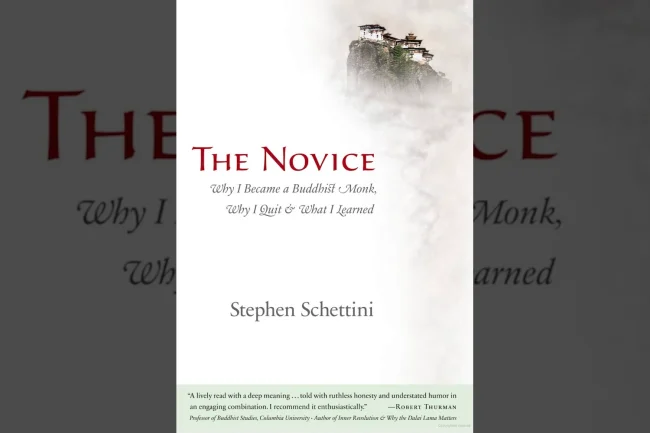
“The Novice,” by Stephen Schettini

"The Novice," by Stephen Schettini

Vishvapani reviews Schettini’s heartfelt and vivid account of becoming a Tibetan Buddhist monk and his valuable reflections on what it means for westerners to practice Buddhism

When I first encountered Buddhism in the UK around 1980 there was already a generation of established practitioners, most of whom shared a common background. They were hippies … or should that be ex-hippies? Their faces lit up as they recounted their adventures: how they set out from respectable homes to discover the excitements of London’s Kings Road, join the flower children in the Haight, or make exotic journeys to the East. There were stories of dope deals that went wrong, revelatory acid trips, close shaves with bandits in the Afghan mountains, and spiritual discoveries in India.

Title: The Novice: Why I Became a Buddhist Monk, Why I Quit and What I Learned
Author: Stephen Schettini
Publisher: Greenleaf Book Group Press
ISBN: 978-1-60832-005-9
Available from: Amazon.co.uk and Amazon.com.

All that is in The Novice. Stephen Schettini grew up in London and Gloucester in an English-Italian family with at least its share of emotional repression and Catholic guilt. At the time, he just wanted to get away and felt increasingly estranged from his family’s petty bourgeois ambitions. With his philosophical leanings and alienation from society, Schettini was a natural recruit to the counter-culture and he eventually hitchhiked along the hippy trail that led stretched from Europe to India. His story was so familiar that it seemed clichéd until it struck me that I couldn’t think of another book that tells it, and that Schettini tells it well. His writing is lucid and vivid, at least once the story gets going, and he doesn’t let the impulse to reminisce get in the way of his tale.

Also see:

In India, Schettini‘s path diverged from that of the Buddhists I had met, who had enjoyed their adventures and come home. He heard that the Dalai Lama and other Tibetan refugees were living in Dharamsala in the Himalayan foothills, and set off to find what they had to offer. The turning point came when Schettini met and studied with Lama Yeshe, “the hippy Lama,” who exuded warmth, taught in English and knew enough about the Western culture to pepper his teachings with humorous asides about supermarkets and consumerism. Something clicked for Schettini when he encountered Tibetan Buddhism: the promise of an inner peace that would resolve his emotional turmoil; a new identity that would end his isolation; a philosophy that answered his questions; and benign, seemingly all-knowing lamas upon whom he could rely.

Schettini soon became a monk and found himself in Switzerland studying with the famous scholar, Geshe Rabten, and sharing an intense existence with several other young monks. Two members of this tight-knit group have become prominent figures in western Buddhism. Alan Wallace is a leading figure in the dialogue between science and Buddhism, and Stephen Batchelor is a writer and teacher whose approach is amply expressed in the title of his latest book, Confession of a Buddhist Atheist (which is also part-autobiography and covers some of the same ground as The Novice).

The intellectual trajectories of Schettini’s fellow-monks suggest the struggles that awaited Schettini himself as he moved from immersing himself in Tibetan culture and religion and hoped to integrate it with the rest of his life. Geshe Rabten’s regime emphasized study, but this turned out to mean memorizing ancient texts and mastering traditional arguments. Debate was on the curriculum, but it involved deploying those arguments skillfully, rather than subjecting an issue to the kind of fundamental inquiry that is found in western philosophy. The monks developed a camaraderie mixed with competitiveness that stopped some way short of intimacy. But the wider community around Rabten included proprietorial lay-women, wealthy donors who were treated as favourites and, later, a younger monks with a starry-eyed faith in the infallibility of their teacher.

Wishing to get to know the Tibetans better, Schettini left Rabten and traveled to Sera monastery in southern India, where he was the only westerner. Living among Tibetans and speaking their the language, the sheen that had made them seem semi-mythic beings faded and Schettini saw their limitations. The monks were immersed in a dogmatic system that closed off the possibility of even posing certain questions, and some thoughts were literally unthinkable within the limitations of the Tibetan language. Meanwhile, they lived in insanitary conditions, and refused to take basic precautions against infection and disease. Schettini returned to Switzerland, skeptical of many aspects of the tradition and was astonished by the naivety of Rabten’s students, who seemed so “dazzled by exotic thinking and ritual” that they accept the Teacher’s decisions without question. Before long he quit.

The remaining 25 years of Schettini’s story are recounted briskly. Unlike Batchelor, whose time as a Tibetan monk takes up just a couple of chapters of his book, Schettini was too snagged by the self-doubt and insecurity underpinning his decision to become a monk to explore other philosophies or Buddhist traditions. In order to live happily in a way that was authentic he needed to uncover the buried emotions that had been with him all along. Schettini realized that the very difficulties he had once fled were, in fact, the keys to his happiness. He needed to face them, and face himself rather than fleeing or blaming the monastic establishment.

Schettini wrote and rewrote the book that became The Novice over many years as he wrestled with his past. But the product is far more than a therapy journal. In reflecting on his life and the religion he encountered Schettini tried to “pick out the gold from the dross.” The personal philosophy he arrives at is a kind of wary spiritually-aware humanism. He mistrusts institutions and dogmatically-held beliefs, holding that “the more deeply we are motivated by emotion, the more insistently we pass it off as reason” and that “denial is a force to be reckoned with and our principal obstacle.”

This is wise, but I read Schettini’s reflections with sadness. I am sad that the reality of Tibetan Buddhism fell so far short of the image that beguiled him and many others. And I am sad that his eventual stance is so circumspect. I believe there is more gold in Buddhism than Schettini acknowledges, however much dross may accompany it. Indeed, I think there are more possibilities in the human condition than he mentions, and that Buddhism speaks to many of them: possibilities of mental development, compassion, and moral excellence. Religious institutions may often be rigid, but that isn’t a reason to give up on creating better ones.

It is over forty years since westerners started to investigate Asian spiritual traditions in large numbers, and many of the institutions they created in their efforts to establish Buddhism in the West are likewise several decades old. It is high time to let go of illusions about both the mystical East or the glorious prospects for western Buddhism and reflect seriously and honestly on what has been learned. The Novice is a heart-felt, frank, informative and eloquent contribution.

See more writing by Vishvapani at Wise Attention

Read More

Miami kicks off Tibetan Culture Week with ceremony

With a pinch of flour thrown into the air with a Buddhist prayer, Miami University students and faculty kicked of Tibetan Culture Week.

About 75 people gathered for a Tibetan prayer flag ceremony outside Upham Hall Monday, March 22.

They stood quietly, some holding burning incenses, in the frigid misting rain as a Geshe Kalsang Damdul, a Tibetan monk, chanted prayers and rang a bell.

Each person then took a pinch of flour and held it above their heads saying together “sooo” three times before tossing it in the air.

“I thought it was a lot different than anything I’d been to before,” said Rachel Howell, a sophomore at Miami, who attended the ceremony for her anthropology class.

Miami sophomore Thea Peterson said she saw prayer flags hanging in temples in India while living there as a child. She also visited her father in Tibet last year while he was living there.

“I just really like the culture,” said Peterson, who attended the ceremony with friends from her Hindi class at Miami.

The ceremony was the first event in a week that will include a meditation session, lecture and others with Geshe Kalsang Damdul. The activities are conducted ahead of the October visit by the Dalai Lama.

On March 24, Geshe Kalsang Damdul will present “An Introduction to Tibetan Meditation” from 9 to 10 a.m. and a lecture “Toward a Compassionate World in the 21st Century” from 3 to 4 p.m. in 212 McMillan.

On March 25, “Global Women’s Day: Tibetan Women” will be from 11 a.m. to 2 p.m. at Shriver Center and a showing of the film “Kundun” will take place from 7 to 9 p.m. in 101 Bachelor Hall.

Read More

Tibetan Culture Week planned before Dalai Lama visit

Oxford Press: Miami University is holding a Tibetan Culture Week March 22-26 in preparation of the Dalai Lama’s visit in October.

The week will offer a series of lectures, meditation sessions and a prayer flag ceremony that are free and open to the public.

Tibetan monk Geshe Kalsang Damdul, assistant director of the Institute of Buddhist Dialectics under the direct administration of the Dalai Lama, will lead the events.

The programs come ahead of the Dalai Lama’s visit to Miami University on Oct. 20-22 to recognize a program that takes students to Dharamsala, India for an entire semester.

“The success of the program is what promoted the Dalai Lama to accept the university’s invitation,” said Professor Deborah Akers. “He receives hundreds of invitations so we’re very lucky he accepted ours.”

The College of Higher Tibetan Studies has taken 65 students to Dharamsala with the semester-long program last fall and summer sessions during the last five years.

Students live among Tibetan refuges and take courses on Buddhist philosophy, Tibetan medicine and meditation, as well as an intensive sequence of language courses in Chinese, Tibetan and Hindi.

“The students return with a broader view on life. It’s a very unique program,” Akers said.

During Tibetan Culture Week, the public will be invited to a prayer flag ceremony at noon March 22, at the Hub near Upham Hall. During prayer flag rituals, a monk recites prayers, burns incense and makes offerings to the gods.

On March 24, Geshe Damdul will present “An Introduction to Tibetan Meditation” from 9 to 10 a.m. and a lecture “Toward a Compassionate World in the 21st Century” from 3 to 4 p.m. in 212 McMillan.

Throughout his visit, Geshe Damdul will meet with faculty and students to discuss Buddhist philosophy and issues between China and Tibet.

On March 25, “Global Women’s Day: Tibetan Women” will be held from 11 a.m. to 2 p.m. at Shriver Center and a showing of the film “Kundun” will take place from 7 to 9 p.m. in 101 Bachelor Hall. The Association of Women Students is sponsoring the events. The film is co-sponsored by Students for a Free Tibet.

Read More

Ashland, Oregon, Buddhist center nears completion

Mail Tribune: With about $200,000 in donated labor from volunteers, a three-story, $1.6 million Buddhist meditation center is nearing completion in Ashland and will open for classes the first week of June.

The 5,800-square-foot home of Kagya Sukha Choling is a blend of traditional Tibetan and contemporary “green-sustainable” architecture — and is being lauded as an “eternal” structure that will offer spiritual and economic benefits.

“It’s a beautiful thing, long-lasting, environmentally friendly and embodying ethics and values we so much need today,” said Kagya Sukha Choling board member Anne Stine. “It’s a gift to the Rogue Valley community, a beacon for Ashland in terms of resources, classes and visitors — and good for the economy and other businesses.”

The center, founded in 2002 in a house on Granite Street, took out permits in 2005 to build at the Hersey Street location and set out to raise just over $1 million for construction.

The ground floor houses offices, library and classrooms. The second floor has a large meditation hall and kitchen while the top floor is apartments for the two lamas, plus quarters for visiting lamas.

An outside porch surrounds the top floor, which shows accents of red and gold. Final touches will include prayer wheels from Nepal, ornamental full moons, dharma wheels, two deer and banners.

In the remaining three months before opening, KSC has to raise the final $75,000 for the project.

Read More

Buddhist monk has inner peace, just needs driver’s license

Knox News: The Buddhist monk reaches a top speed of 5 mph as he maneuvers his 16-year-old Toyota around the grounds of the meditation center in West Tennessee.

It is a practice excursion to make sure that the monk, Khenpo Gawang Rinpoche, is familiar with the car the next time he takes his driver’s license test.

A scholar among Buddhists, he has the equivalent of a doctorate in religion and literature. That means nothing to driver’s license examiners who have flunked him three times on Tennessee’s written driver’s exam.

“It’s kind of important to drive, to be independent, but language is a problem,” says Khenpo, who lives about a mile from the meditation center that he founded here two years ago.

He wears the same deep amber and burgundy colors as those worn by one of his heroes, the Dalai Lama, leader-in-exile of Tibet. The amber represents wisdom, the burgundy compassion.

Like the Dalai Lama, the monk fled Chinese-occupied Tibet to study in India. The Dalai Lama was born to a farm family. The monk was born to yak herders. The monk has studied in group sessions with the Dalai Lama as his teacher and thinks of him primarily as a religious figure – “the holiest of monks, a good and great teacher.”

He also thinks of the Dalai Lama as a political figure, campaigning for world peace and for self-determination for Tibetans in an occupied country.

The monk and his students bought tickets as soon as they became available for the Dalai Lama’s visit to Memphis on Wednesday to accept an International Freedom Award from the National Civil Rights Museum. He later spoke at The Cannon Center for the Performing Arts on “Developing Peace and Harmony.”

For the monk, peace and harmony will improve when he finally gets a driver’s license. He has to rely on students to drive him to and from the center, the grocery store and to the orthodontist. As part of his adaptation to Western culture, he began wearing braces a year ago to correct an overbite that interfered with his ability to pronounce certain sounds in English.

Students call him “Khenpo,” a title that means teacher. His given name is only one name, Gawang. Rinpoche is another title, recognizing a lineage of revered teachers or mentors.

Khenpo, 35, began studying English seriously in 2007 when he decided to open the Memphis center, the Pema Karpo Buddhist Meditation Center. He has learned to use a computer along with Photoshop software and Skype, software that allows him to communicate by live computer video with other Skype users. When his English improves, he hopes to teach Buddhism and meditation to students anywhere in the world.

But his immersion in English language courses like Rosetta Stone and children’s programming on TV are, so far, no match for the written driver’s exam.

“Abbreviations very bad,” he says. Along with standard fare about lane changes and turn signals, the exams include abbreviations such as “DUI” (driving under the influence) and “BAC” (blood alcohol content).

“It’s confusing for him,” says Candia Ludy, a Memphian and former Baptist who formally converted to Buddhism in 1987. She was working as a coordinator of courses on Buddhism at the Shambhala Mountain Retreat near Boulder, Colo., when she met Khenpo in 2005 and invited him to Memphis in hopes he might open a center here.

One of his Memphis students, attorney Halley Marker, says Khenpo’s decision to open the Memphis center showed a “pioneer spirit” willing to bring Buddhism to the Bible belt.

Having his own center was a longtime goal for Khenpo, whose work also includes translating ancient Tibetan texts into English. His dream of a driver’s license also is a longtime goal. As a 10-year-old child, he visited Tibet’s capital, Lhasa, with his father and saw cars for the first time. When they returned to their mountain village, Khenpo and his brothers used frozen yak dung as makeshift wheels to build toy cars.

In Buddhist tradition, Khenpo does not worry about his driver’s license failures or fear his next exam. “Sometimes we need to accept our own karma,” he says.

He knows of nothing he did to account for his three flunked exams, but in Buddhist tradition he does not dwell on the past. “If you want good things then you must do good things.”

Read More

In the Arizona desert, Buddhists will embark on a three-year silent retreat

LA Times: Deep in a remote desert valley, where rattlesnakes lurk in the scrub, Stéphane Dreyfus and several dozen other Buddhists are preparing to undergo a mind-altering journey:

Three years, three months and three days of silence.

There will be no word from the outside world in the Great Retreat, only the deafening quiet of rock and cactus, with seemingly endless time to ponder the emptiness of life.

Dreyfus and his fellow adherents hope to find enlightenment in the silence, a gift they plan to share when they emerge from their long seclusion.

They know that outsiders might dismiss them as eccentrics on a strange utopian trip, but their resumes suggest otherwise. Among them are an airline pilot, a dermatologist, a retired biochemist and a former television editor.

They’re jettisoning the trappings of their middle-class lives to carry on a Buddhist tradition that traces its lineage through the Dalai Lamas of Tibet. For many in the group, that means leaving behind six-figure incomes, young children or aging parents for the solitude of cramped retreat cabins made of adobe, wood — even hay bales.

Prolonged silence, they explain, is the only way to reach the deep level of inner awareness required to bring true happiness to the world.

“If I can get to the position of being perfectly free of suffering and develop high levels of mental clarity that cause enlightenment, I can show others how to get there perfectly, quickly,” said Dreyfus, 32, who left a job as an assistant editor on the prime-time show “The Bachelor” to teach yoga and prepare for his undertaking.

Read the rest of this story…

Dreyfus, a Berkeley native, will be joined by his fiancee, Jessica Kung, a Yale graduate and also a yoga teacher.

When they start the retreat late next year in this corner of southeastern Arizona, they will be newlyweds, sharing a 500-square-foot cabin, communicating only through gestures and facial expressions, and refraining from physical intimacy. Such pleasure, they both say, would dissipate prana — inner energy — distracting from the important karmic work at hand.

“I feel a desire to have some serious PhD-like study in yoga [and] meditation,” said Kung, 27. “There is nothing better to do with my youth.”

Such talk provokes bewilderment, skepticism and even anger from the family members of many of those who will join the retreat.

Hubert Dreyfus, a professor of existential philosophy at UC Berkeley, worries that his son Stéphane is wasting his talent for writing and filmmaking to pursue ideas he sees as irrational.

The elder Dreyfus conceded his son is happier than ever. Still, he can’t understand why anyone would leave loved ones behind to disappear into the desert — in this case, for 1,190 days. “I’m just torn,” said Dreyfus, 79. “I want grandchildren.”

Enlightenment isn’t cheap.

Each retreat participant will need $60,000 to $75,000 to build a cabin and pay for three years of food and supplies (the menu will probably include such staples as lentils, rice, beans, potatoes and other fresh vegetables).

Some already have set aside the money. A few are searching for sponsors at yoga and meditation seminars, or relying on the generosity of others on the retreat.

“I’m waiting for a miracle,” Ben Kramer, a 33-year-old Floridian, said recently as he practiced yoga poses with his girlfriend inside an adobe temple not far from the retreat site.

Those on retreat will cook for themselves in cabins equipped with kitchens and bathrooms. Power will be supplied by solar panels or propane tanks, and members will probably have air horns to summon help if something goes wrong.

Volunteer caretakers, fellow Buddhists who live nearby, will help by growing or shopping for food and dropping it off twice a week. David Stumpf, a retired plant biochemist from the University of Arizona who is planning to join the retreat, is in charge of installing a water supply system in the valley.

Stumpf has nearly finished building the 600-square-foot cabin he and his wife, Susan, will share on a small patch of earth surrounded by paddle cactus and ocotillo plants, whose red blooms shoot from the ground like Fourth of July fireworks.

Surveying the rolling landscape and cloud-streaked sky one recent day, the 56-year-old proclaimed the setting ideal for deep meditation. “This place is stunning at sunrise,” he said. “The lighting on the hillside is just magical.”

To reach “retreat valley,” drive 107 miles east from Tucson on Interstate 10 through empty stretches of desert to the small town of Bowie, then head south on a narrow asphalt road. From there, a rutted dirt roadway leads to Diamond Mountain University, a nonprofit Buddhist campus where footpaths connect an adobe temple, a tented student lounge and round Mongolian-style yurts.

Another short road from the university to retreat valley is even more primitive, coursing through brush-covered hillsides once home to a cattle ranch.

In the heart of the valley is a single yurt within sight of several cabins under construction. This is the home of Geshe Michael Roach and Lama Christie McNally, the university’s founders.

Roach and McNally were born in Los Angeles, two decades apart. Both grew up as Episcopalians.

An altar boy in his youth, Roach, 56, thought he might become a minister. Then he traveled to India while studying religion, Sanskrit and Russian at Princeton University. He was driven by a question he believed Christianity did not address: If God existed, why did people suffer and die?

It was a poignant query; Roach’s mother and father had died of cancer about the time he was finishing high school, and his brother had committed suicide — all within a year of one another.

Buddhism offered him answers: Life and death had no intrinsic meaning. Instead, reality depended on perception. Through meditation, yoga and other practices, negative thoughts could be replaced with positive ones, allowing karmic seeds planted in the heart to ripen into happiness.

The idea of karma was key: How people acted in the past determined what they experienced in the present. Roach spent two decades studying at monasteries in India and the United States. He was ordained a monk in his early 30s and later earned a Geshe degree, the equivalent of a doctorate of divinity, one of the first Westerners to do so.

McNally, 36, who studied philosophy and literature at New York University and then traveled to Tibet and Nepal, met Roach at one of his teachings in New York in the late 1990s. They have been spiritual — though celibate — partners for a decade, they say, an arrangement that has provoked criticism from some Tibetan Buddhists and scholars, who point out that monks are barred from relationships with women.

In 2006, the office of the Dalai Lama, the spiritual leader of Tibetan Buddhism, cited Roach’s “unconventional behavior” in rebuffing his effort to teach in Dharamsala, India, seat of the Tibetan government in exile.

“The older lamas are disapproving,” said Robert Thurman, a professor of Buddhist studies at Columbia University, who considers Roach a friend. “People have their fingers crossed that he will turn around and eventually do the conventional thing.”

Roach and McNally respond that their stream of Buddhism encourages such partnerships, and that other Buddhist teachers have done the same, if privately. The difference, they say, is that they publicly acknowledge theirs.

The two devote themselves to disseminating Buddhist teachings. They have written several books on meditation and yoga, and have preserved ancient manuscripts in an extensive online database.

In 2000, they led four other Buddhists in three years of seclusion on a ranch not far from retreat valley. Each day, they rose at 3:30 a.m. for the first of four extended meditation sessions, which were often conducted in 120-degree heat. Several times, they emerged briefly from their yurts — and Roach from his silence — so that he could share insights. The members wore blindfolds to help them maintain their solitary states.

“We believe that everybody is in pain right now, because they have all these negative thoughts running in their heads all the time,” Roach said recently. “If you can figure out how to stop your own pain, then you can teach other people how to stop theirs.”

The retreat participants were so isolated that they did not learn about the Sept. 11 attacks until they came out of seclusion nearly 21 months later. “We still haven’t seen the footage,” Roach said.

The project was not without mishap. One member was bitten by a rattlesnake and had to be taken by ambulance to a Tucson hospital. The same woman left briefly to care for her dying father after she received a letter informing her of his failing health. Her departure was disruptive to the others, they say. But she returned to finish the retreat, and went on to complete another.

Roach and McNally say they believe the first Great Retreat produced a concrete result: the birth of their university in the dusty flats just below the valley’s gates.

Now, hundreds of students converge on Diamond Mountain throughout the year, supporting the university with donations and taking classes in such subjects as the nature of omniscience and the purification of negative karma. Classes are free, but luxuries are scarce. Student housing consists of yurts, pup tents or mobile homes stationed in the dirt parking lot. Wasps dart overhead and the heat is ever present.

Despite the harsh conditions, Bill McMichael of Chicago jumps at every opportunity to visit Diamond Mountain, sometimes bringing along his daughter and son, ages 7 and 9.

The 42-year-old American Airlines pilot said he intends to quit his job flying DC-9s to enter the three-year retreat. He also will take a lengthy leave from his children, who will live with his former wife. Friends will bring the kids to retreat valley two or three times a year, but McMichael will not be allowed to speak to them, communicating only through gestures or notes.

“Leaving the kids is the most difficult part,” he said.

McMichael has tried to explain the retreat in terms the youngsters can understand, telling them that he is going to become an angel and reach heaven, and that he will show them how to become angels too. He sees a rare opportunity to bequeath them ancient wisdom.

“I can give them something that death can’t take away,” he said.

Read More
Menu

Wildmind is a Community-Supported Meditation Initiative. Explore the benefits of becoming a supporter.

Close Welcome Bar